Side-hustling for three years before going all-in and hitting $6.4k MRR

Products #5 and #6
Hi, I'm Jonathan. I've been a software developer at a small startup for almost 5 years. For the last 3 years, I built side projects on nights and weekends.
I sold my first product, LectureKit, for $7k. WaitListKit got one pre-sale, but I decided I didn't want to build it and refunded the user. I made $400 with zero marketing on NextUpKit, but then made it free and open source. And then, I grew CaptureKit to $127 MRR and sold it for $15k 2.5 months after launch.
This month, I left my full-time job to become a full-time indie developer and grow my products! My focus is on my fifth and sixth products:
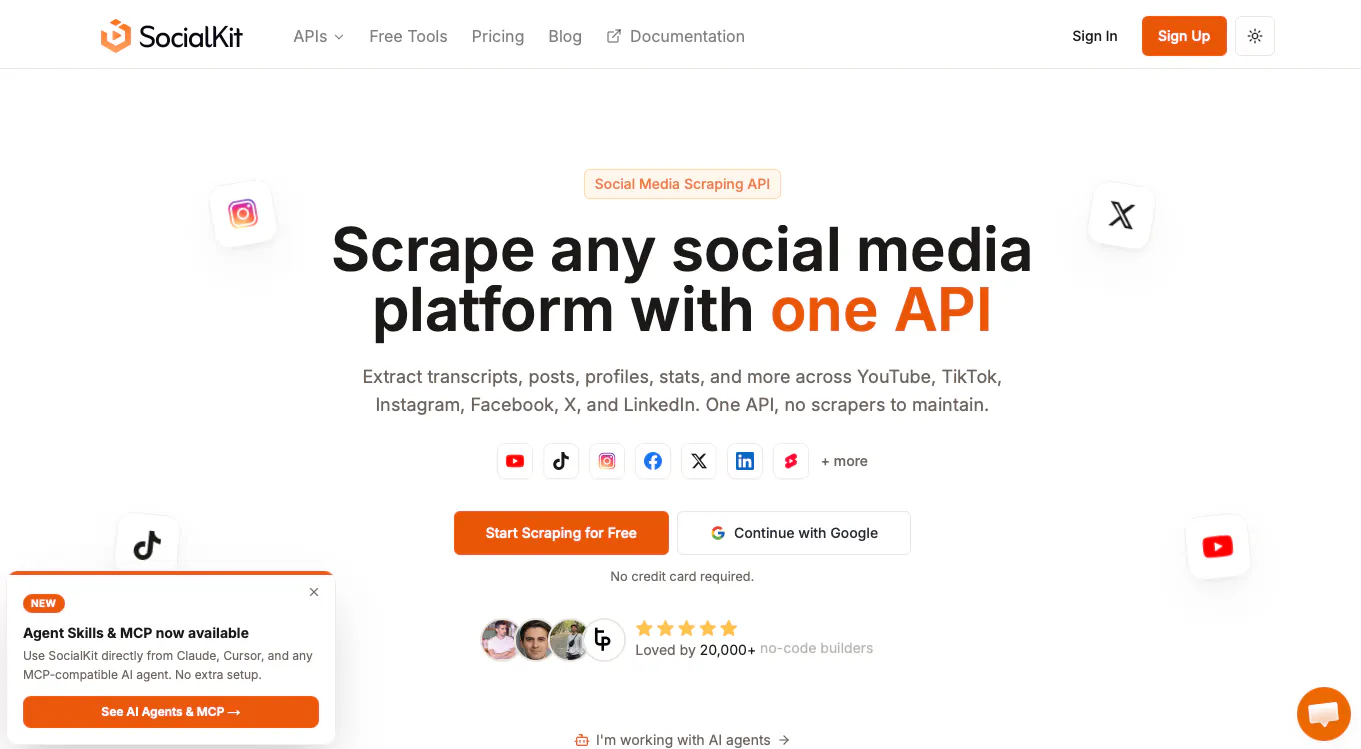
SocialKit turns social media content into clean data: transcripts, comments, stats, profiles, and AI summaries from YouTube, TikTok, Instagram, Facebook, LinkedIn, and Twitter/X, with one API. It launched 13 months ago and grew to ~$3.5k in monthly revenue ($2.8k MRR plus ~$700 average one-time payments) with 110 active subscriptions.
PostPeer offers a unified API to schedule and publish content to every major platform — LinkedIn, X, Instagram, TikTok, YouTube, Facebook, and more. It's my newest and fastest-growing product. I launched it in April 2026, and it has a revenue of ~$2.9k/mo ($2.4k MRR plus ~$500/month in one-time payments), with 1k users.
A framework for ideation and validation
It started as curiosity more than a business plan. I had a good dev job, but I kept seeing indie hackers on Reddit and X sharing their numbers and thinking, "I could build that."
I built my first products based on whatever I thought was cool, and that showed. So, I stopped trying to be original and started actively looking for competition. My rule now: At least 2-3 solid competitors, each doing roughly $20K-$80K/month, in a niche I understand. If there's no competition, I don't build it, because it usually means there's no real demand.
Competitors already making money IS the validation. That rule led me to CaptureKit, which was my biggest sale. And it led me to my niche: API products in the scraping, data, and automation space. Developers and automation people pay for reliable APIs, and as a developer, I know exactly what the buyer wants.
If my idea has competitors and I understand the customer, I put it through one more test. Can I differentiate slightly without reinventing anything? I don't try to out-feature anyone. With SocialKit and PostPeer, the wedge is speed of support and early adoption of the AI-agent use case. Small, real differences beat original ideas.
Take the leap from solid ground
Financially, I spent almost nothing: domains, servers, and some AI subscriptions. The real cost was time: nights and weekends for three years while I worked full-time. I made that sustainable by shipping small and marketing during development instead of after. By the time each product was "done," blog posts already ranked, free tools brought traffic, and early users gave feedback.
My advice? Build while you work if you can. It's slower, but you get to take the leap from solid ground so you don't have to work from a place of desperation.
Infrastructure and the stack
I used CaptureKit's infrastructure when I built SocialKit: auth, billing, API key management, docs structure, even the landing page patterns. This is a key part of my approach now. Every product makes the next one cheaper to build.
PostPeer took longer because social platform integrations are genuinely painful. TikTok's approval process alone — if you know, you know. It's also the first product I'm not building alone; I work on it with a partner, which changes the pace. My partner splits platform integrations with me and keeps shipping when I'm deep in SocialKit.
As far as the stack, TypeScript everywhere. Both products are Next.js on the frontend and Fastify APIs on the backend, MongoDB for data, Redis (Upstash) and BullMQ for queues and rate limiting, and AWS Lambda for the heavy scraping workloads.
For payments, SocialKit runs on LemonSqueezy (I hate everything about them), and PostPeer runs on Polar (love them, at least for now!).
Resend handles emails, and Gemini/OpenAI power the AI features. PostPeer is a pnpm monorepo (web, API, MCP server, background jobs), which keeps everything shippable in one place.
Hosting is where the stack keeps changing. I started with everything on Vercel, super convenient with Next.js, but it got expensive really fast once API traffic grew. I moved everything to Railway, which cut costs a lot, but lately, they've been having so many issues that I might move again — probably self-hosting on a VPS next.
And Claude is my team, from writing code to (recently) running my social media through my own API.
How to price
Both products use the same model: subscription tiers based on API usage (credits), plus one-time credit packs for those who prefer not to subscribe. The one-time option matters more than I expected. It adds a consistent $500-700/month per product, and developers who hate subscriptions often start with a pack and later convert to a plan.
New users receive 20 free credits to test the API, no credit card required. This is the entire free offering; after that, it's paid. Every product has paid plans available from launch day. The first paying customer usually arrives embarrassingly early ($13 MRR in month one for SocialKit, $34 for PostPeer), and these early payments teach you more about your pricing than any research.
And here's something I learned that paid for itself: Placing customer reviews at the top of the pricing page increases sales.
My advice is to price against your competitors — they already validated what the market pays. Offer paid plans from day 1, and offer people a way to pay without a subscription.
Compounding channels beat spiking channels.
My "launches" are anticlimactic: I launch quietly. PostPeer's first customer came one week after a quiet launch, before any real announcement, because the SEO groundwork was already live. The classic launch platforms did not help me: SocialKit hit #1 on Uneed, and I used Product Hunt, but neither made an impact. Compounding channels beat spiking channels.
I focus on SEO, starting it before and during product development, never after. My system includes 1-2 relevant blog posts a week, a landing page for every API/feature, use-case pages, and competitor/alternative pages. My guiding trick: I watch search trends and search as my customers would, then create content for every relevant query. This includes YouTube: videos targeting those same relevant queries rank in both YouTube and Google search.
Don't skip these basics: Google Search Console from day 1, submitting your sitemap, internal linking, and some directory submissions for early backlinks.
Reusing content multiplies these efforts. One piece of content becomes many: A YouTube video becomes a blog post with the video embedded, then a LinkedIn post, a Reddit post, shorts, and TikToks. Alternative pages also get videos. The same content in different shapes ranks or reaches different audiences.
Free tools are another compounding piece: A YouTube transcript extractor, for example, ranks, brings steady traffic, and converts some users.
And it turns out that ChatGPT and Perplexity surface competitor/alternative pages; paying customers found me through LLM recommendations.
Beyond SEO, I build in public. I share real numbers on Reddit and LinkedIn; one recent post garnered 27K views and brought a wave of sign-ups. These posts also generated acquisition offers for my previous products. Once users arrive, retention is simple: I answer support in minutes and talk to users directly, even on WhatsApp. This appears in almost every review, and it's the one thing bigger competitors cannot copy.
Finally, timing was a helpful force that was outside of my control. The AI-agent wave arrived exactly when I had two APIs ready to plug into it. MCP didn't exist when I started building, and now agents contribute a real share of my signups.
Business school via YouTube
YouTube has been my business school. I developed most of my playbook (competition as validation, marketing before product, charging early) by absorbing that content for free while building at night.
Here are some resources:
For bootstrapping, Rob Walling, and especially this video
For SEO, Edward Sturm
For AI coding, Chris Raroque
For fun, this.
Daniel Sternlicht, the CEO at the startup where I worked full-time, was a significant help too. Shoutout Daniel! Working next to him for almost five years provided a masterclass in building products and shipping fast; I applied much of that to my own products.
Wrapping up with some advice
Here's my advice:
Build while you work (if possible). I didn't quit until my products made $3K+/month. Take the leap from solid ground.
If there's no competition, don't build it. Competitors making $20K-$80K/month ARE the validation (for me at least).
Start SEO and marketing before and while building, never after.
Have paid plans from day one.
Talk to your users, even on WhatsApp. Fast support is the one thing big competitors can't copy.
Make one piece of content do five jobs: video -> blog -> LinkedIn -> Reddit -> shorts.
Share real numbers. The posts I was scared to publish brought customers and acquisition offers.
What's next?
I'm not 100% sure what's next, to be honest. For the short term, I'll grow PostPeer and SocialKit to $10K per month each. That or sell for a good deal.
Other than that, I want to be happy, build stuff I enjoy building, and have free time for fun stuff.
And of course, I definitely want to sell a product for $1,000,000+. That's the dream!
You can follow along on X, LinkedIn, and Reddit. And check out postpeer.dev and socialkit.dev!

Leave a Comment
The "competitors making $20-80K/month IS the validation" reframe is the one that'll stick with me. Most people treat existing competition as a reason not to build something, when it's actually the clearest signal the demand is real.
Also the pricing note about no free tier, just 20 credits and then paid from day one. Scary to launch that way, but it sounds like it forced honest signal way earlier than a generous free plan would've.
Curious how much of the jump from SocialKit to PostPeer's early revenue was new signups versus existing subscribers just not churning off on renewal. With usage-based credit pricing specifically, I'd guess failed or expired cards on renewal hit differently than a flat subscription would.
Thanks a lot for featuring me! Appreciate it (:
That is one amazing journey. Hoping to see your growth!