Seeking opinion: Early founder risk
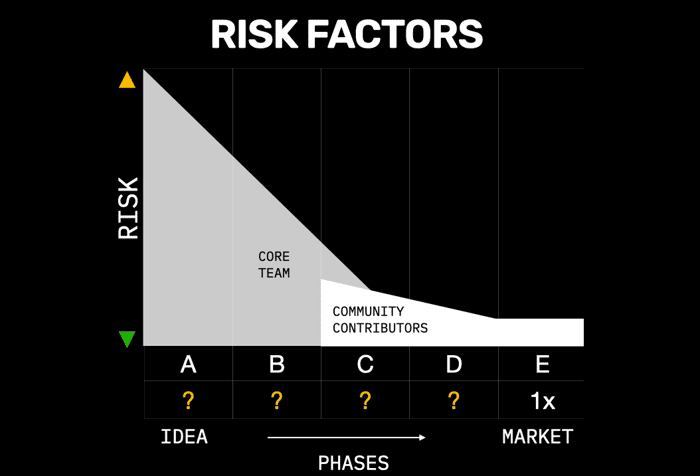
Hey 👋 founders!
I'm looking for your opinions with the end goal to create a 'rule of thumb' guide for valuing founder contributions. I'll incorporate the results into a product I'm building and credit IH.
BACKGROUND
In any bootstrapped startup, web3 community, DAO etc the initial founders wear the early risk. The founders’ experiments may fail and their work may be worthless up until the product gains traction. Over time the community gets behind the mission and ultimately the product “meets the market” and garners paying customers. At this point the risk is 1:1 meaning effort is directly remunerated.
A startup evolves through phases of risk (from A “high” to E “low”) as a product progresses from Idea to Market. Phase Outcome & Examples of Activities:
A = Minimum Viable Product (ideation, building, iterations)
B = Product Beta (gathering early customer feedback, iterations)
C = Market Ready (creating promotional materials, raising capital)
D = Active Community Established (growth and engagement campaigns)
E = Paying Customers
QUESTION:
What is the risk factor of the contribution made at each phase?
E.g.:
If you think A is 100 times.
Then A = 100 x
YOUR ANSWER:
A = ? x
B = ? x
C = ? x
D = ? x
E = 1 x
Share your opinion on the [?]x values and your rational if you like.

Let's try to assign risk factors to me and https://skilledup.life - free talent for tech startups
Bit of history https://www.skilledup.life/background-to-skilledup-life/
Predecessor (Furloughed Life) gave a taste.
Went live with SkilledUp Life on 1st Aug 2020 as a commercial business. Took me less than three days to build the product using WordPress. We still run this version 26 months after. My cost was about £100 if you consider buying a WordPress theme, domain, hosting, etc. So in this case, from a risk point of view, it was very small.
What I want to show is that risk goes up instead of down as you would typically expect, as per your graph.
We immediately had customers, but the focus was not on revenues for a long time. It took me 176 days to sign up 100 volunteers. Half way through I employed our first and only employee. At this point, the risk went up as I had to pick up his salary.
We hit the first year target of signing up 1000 Volunteers with 24 hours to go. Risk went down at this point.
We hit the second year target of adding 10,000 but 9 days later than planned. We never hit our second year customer number. At this point risk went up again.
I told everyone that I would hit £10k MRR by end of Oct 2022. We have not even gone past £1k MRR yet. So for me, the risk is at the highest now. Much higher than when I started.
Hope this gives a different perspective to your thinking @dayninja.
All the best
[email protected]
PS: Since then I have sunk more costs. Most likely, I will raise a small debt finance round but no plans to raise equity. I don't want investors to change the focus of SkilledUp Life as they all want me to monetise the talent. That's not what SkilledUp Life is about.
I love your glorified slave labor startup
Would you be happy if we charge volunteers a nominal fee for providing real experience to improve their career prospects?
Thanks @ManojRanaweera for sharing this. So if you were to bring in a co-founder. Assuming you were bootstrapping: At which stage would it have been most advantageous? what would their role have been? and in retrospect what incentive would you have given them?
i.e. 1x, 2x, 4x, 5x... their usual income/rate?
I don't need a co-founder. For me, co-founders are a pain in the backside. I have one employee. Planning to bring two more soon - Both are current Volunteers. We have about 30 Volunteers helping us. We could increase this number to about 100. To help our next phase of growth, I plan to take on a small loan.
https://skilledup.life is a different type of organisation. We help those who are self-funding their tech startups with free talent (once subscribed).
Really like this question!!
It's always risky to be an early founder, because you're essentially starting from scratch. You have to be prepared to work hard and hustle to get things off the ground, and there's always the possibility that things won't work out. However, I think it's important to remember that even if a startup fails, it's not the end of the world. You can always learn from your mistakes and try again.
I can talk about this a long time over some beers, but my best advice would be: Read Slicing Pie (https://slicingpie.com)
TL;DR: Keep it simple, don't get lost in valuations this early. Bookkeep hours and money (x2). Extra advice: Be critical about handing out shares, I'd keep the circle small
Hi @Sbalen a virtual 🍻 would be great! I know the slicing pie model and the author. The purpose of my post is create a conversation setting aside the conventional wisdom with fresh thoughts. I've come at this from DAO / web3 community needs. From that angle there are opportunities to take a different approach. I'm on twitter @emotf, pls DM as I'd really like to dig into this deeper with you.
If I understand this right, I'd say something like:
A) .01 B) .01 C) .01 D) 1 E) .1
So, in short the risk isn't in the product dev, it's in the market acceptance - and further, the monetization model (although there's less risk there than in market acceptance). Meaning, if you get a large enough audience, even in an unattractive niche, you can monetize.
There are startups, like "deep tech" where the risk is theoretically all in the product development phase. However, they're rare birds.
Thanks Mark. Yours is an interesting take.
Perhaps I should re-phrase for clarity... Let me put it this way:
What is the likelihood that $100 in time a founder contributed in Phase A would give them a return?
Or for each $100 in time forgone by choosing to work on the project as opposed to earn 1:1 (time:$)... At what factor should they be rewarded for taking that risk should the project be successful?
Yes, Phase D is crucial and highly valued for commercialisation yet investors would typically refer to this as 'de-risked' as there are already customers / orders i.e. demand proven.
For this model: I've indicated risk factor 1x when the product is in the market.
So to understand your rationale and view point you're inferring contributors in Phase D have borne 10x the risk of those in all other phases of contribution?
Yes.
Phase D is 100X the risk of product dev. Take 100 apps. 1 might be bona-fide successful. These are approximate numbers, but they're not too far off from reality, I believe.
Maybe borne 100x the risk, or maybe they're just 100x luckier.
Hi Mark,
I've been doing some research and pondering more.
I can't post an updated diagram here, but I posted it on twitter. https://twitter.com/emotf/status/1580721363119407104 This may better represent your perspective. Happy to do deeper on it if you're up for a chat?
I looked at your graph. I'd illustrate it with 2 lines - a risk line, and a reward line. Importantly, they are independent of each other. For example, I can go out and take a lot of risk, without pretty much any likelihood of reward - that's easy. That's uncompensated risk. How much the risk line increases would depend upon what kind of product is being built - if you're throwing all your money at it - that's hugely risky. But if it's a simple, cheap product, there might not be much if any risk - the community could simply go "meh" if it's lame, and soldier on.
Another thing is risk is arguably increasing with time with community projects, because people drop off engagement. So unless magical things happen pretty quickly, even if you get a bunch of initial users, they might not even much remember what they signed up for in a month or 2.
Feel free to ping me. I drew it for you: https://s3.amazonaws.com/appforest_uf/f1665711025580x660831020806264400/IMG_1093.JPG
Great input Mark! Thanks again for sharing. Please drop me a DM on twitter so I can contact you.
Says I can't message you on Twitter. You can message me on my app VCvsME.com if you want though!
This is a great question, and I believe I can be more helpful if I share my experience as the founder of ScrollBites in an open, non-specific way.
I see stages A, B, and C as a cycle as opposed to sequential path that leads to D. Let me explain:
Closing words: risk is present in all stages, however, I see it decreasing as soon as you notice user or customer retention (which could be the result of repeating A->C 20 times). But as long as you're seeing users that come and don't come back, you're still at high risk and need to go through the cycle again.
I hope that gives you some insights, good luck!