Seeking: builders who've solved "task done" ≠ "decision closed"
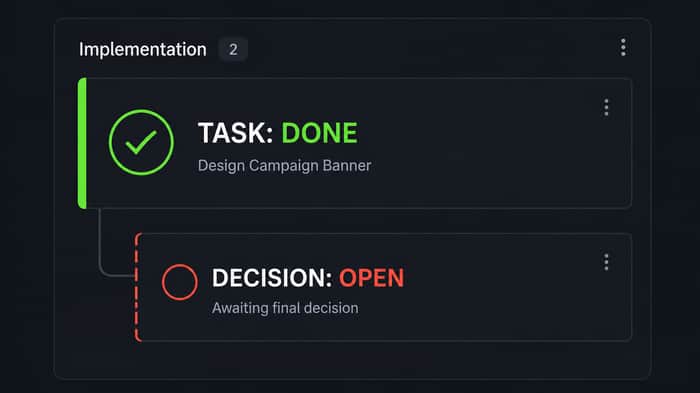
Task trackers are lying to you. A checked box means someone did something. It doesn't mean anyone decided anything.
I keep running into the same async failure mode: a task gets marked complete, but the actual decision it was supposed to produce — pricing, scope, go/no-go — never got closed. So the task disappears from the board while the decision it was standing in for just... floats. Nobody notices until it resurfaces two sprints later as a "wait, did we ever actually decide this?"

This is a real problem, especially as teams and projects grow. Tasks can get checked off while the actual decisions, ownership, and follow-ups remain unresolved.
I can help you build a solid, professional solution around this that keeps things clear, connected, and under control.
If you're interested, let me know.
That's spot on. A checked box doesn't mean a decision was actually made or ownership was settled.
Most of the time, the task just disappears while the real decision floats around, only to resurface weeks later as a bottleneck.
If you're looking to lock down backend loops and decision funnels cleanly without calls or meetings, feel free to reach out directly:
[email protected]
The disconnect between shipping a feature and getting a sign-off usually happens because the 'done' criteria weren't agreed upon before the work started. When I shifted from just tracking tasks to documenting the expected outcome of a decision, the loop closed much faster. Try creating a simple 'decision log' or a mandatory 2-sentence summary for every task that states not just what was built, but what specific metric or feedback loop it aims to trigger. If that summary doesn't exist, the task isn't ready to move into the implementation phase.
Spot on. That's exactly why we treat the 'done' marker as a symptom rather than a resolution.
When a task closes without a designated metric owner or an explicit decision threshold, it quietly drifts into the async void. A decision log works precisely because it forces ownership before code hits production.
We map these exact handoff friction points and silent multi-agent loops asynchronously: https://app.notion.com/p/TRS-Async-Operations-Hub-3b438fc9c442806eaf93e6fdf44873e5
Make the decision the parent record and tasks the evidence. Required fields: owner, options, decision deadline, acceptance threshold, default if time expires, and final outcome. A task can finish without closing it; the decision cannot disappear until the outcome or default is recorded. That avoids adding check-the-checker subtasks.
This is pure engineering elegance. Reversing the hierarchy so the "Decision" is the parent record completely obliterates the checking-the-checker anti-pattern.
Setting a "default if time expires" field is exactly how we prevent asynchronous deadlocks. If the human owner doesn't act before the decision deadline strikes, the pre-configured default logic executes automatically to keep the operational pipeline non-blocking.
We actually mapped a similar DB schema for our async architecture to handle loose ends. Love the raw field metrics you listed here—especially the acceptance threshold. Cheers for bringing structural clarity to this thread!
Hey @peaceful_77 I have seen this a lot over the years, and for me it's a simple case of not separating the ultimate action from the given task. Almost like cooking a meal and then forgetting to eat it - every task shouldn't just have a description; it should also have an ultimate action or a WAWTTA (What are we trying to achieve) note allocated to it. A good way of ensuring the end goal isn't lost is by allocating a sub-task to the main task, the sub-task acting as the final check point to say ok the task is complete; now we need to do something with it.
"Cooking a meal and forgetting to eat it" is the most perfect metaphor for this pain. Love that.
But in my experience with remote teams, allocating sub-tasks to guard the main task often triggers a secondary failure mode: "System Bloat." Teams start creating tasks to monitor tasks, and people end up checking off the sub-task as "done" without actually closing the hard decision. It just relocates the freeze.
We found that instead of adding sub-tasks, enforcing a strict "Decision-Owner" field with an auto-expiry rule is the only way to bypass this drag.
Since you clearly see the friction here, drop me a line at [email protected]. I'd love to share the 1-page playbook we use to eliminate this exact sub-task loop.
good
💬 Want a free TRS Friction Diagnosis? Just drop a 1-line real case below, exactly like this: