I’m building a Product Hunt alternative for indie makers — what would make you actually use it?
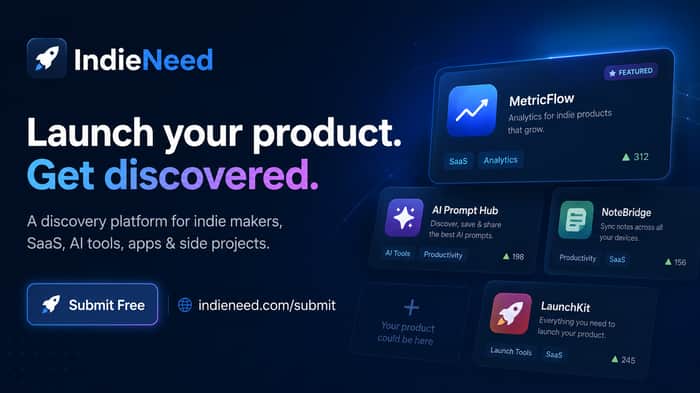
I’ve been building IndieNeed because I kept noticing the same problem:
You spend weeks or months building a product.
You finally launch it.
And then… almost nobody sees it.
Big launch platforms are extremely competitive, social media reach is unpredictable, and many startup directories feel like places where you submit a link and never get anything back.
So I started building IndieNeed — a product discovery and launch platform focused on indie makers, SaaS founders, AI tools, apps, and side projects.
The goal is simple:
• Make it easy for small products to get discovered
• Give founders a permanent product page + backlink
• Let the community upvote and discover new launches
• Give makers another source of early users and traffic
• Eventually provide useful launch analytics instead of just vanity numbers
I’m still improving the platform, and I’d rather build what founders actually want than guess.
So I have 2 questions for Indie Hackers:
- What would make you submit your product to a new launch platform?
Traffic? Backlinks? Feedback? Rankings? Newsletter exposure? Analytics? Something else?
- What do you hate about existing product launch platforms?
I’d love brutally useful feedback.
And if you have something you’re currently building, feel free to submit it — I’d love to personally check out the first Indie Hackers launches:
👉 https://indieneed.com/submit
Happy to answer any questions about what I’m building too.

A permanent page and a durable backlink are necessary, but they are not why I would switch. What I actually need from a discovery platform is signal after the spike: who came back, which problem page converted, and whether the traffic matched the buyer I am trying to reach. Launch day upvotes are easy to game and hard to learn from. If IndieNeed can show me that a visitor returned a week later or bounced for a specific reason, that is more useful than another badge on my landing page.
Huge congrats on building this! I'm curious about your process: when it comes to your content strategy, did you lean more into long-form SEO to drive traffic, or was it mostly community-driven engagement that helped you convert those early users? Also, did any specific AI-powered tools help you scale your workflow as things started picking up speed? Keep building!
For me, the biggest reason to submit to a new launch platform would be qualified traffic, not just another badge or upvote count.
If I’m submitting a product, I’d want to know that the people discovering it are actually founders/builders who might use it — and ideally see where that traffic came from.
The biggest thing I dislike about existing launch platforms is that a lot of the launch feels like a one-day spike. You get votes, comments, maybe some traffic, and then the product disappears.
A platform that gives products long-term discoverability + useful analytics + recurring exposure would be much more interesting to me.
One thing I’d definitely prioritize: make it extremely easy to discover products by problem/use case, not just category. That could become a real differentiator.
The part about discovering products by problem and use case is an excellent idea that's lacking from most product launch platforms
Honest answer from someone whose acquisition is 100% organic search and has never done a launch: a one-day vote spike is worth almost nothing to me. My users arrive one at a time through search, over months.
What would actually make me submit is a permanent, indexable product page, a durable (ideally followed) backlink, and honest categorization so I can show up for the problem I actually solve rather than compete in a launch-day popularity contest.
PH’s value is the spike. The durable-page part is the gap you could actually own.
The main thing that would make me use something like this is if it felt less about launch-day spikes and more about sustained discovery for smaller products. Curious how you’re thinking about that part.
For me, the biggest reason to use a new launch platform wouldn't be another product page or backlink — it would be the feedback loop after submitting.
A lot of launch platforms are great at creating a spike of visibility, but once the launch is over, there's not much reason to come back.
I'd be more interested in something that helps answer: who actually discovered my product, what caught their attention, what they didn't understand, and what changed after the launch?
Even lightweight structured feedback around those questions would be more valuable to me than another upvote count.
The interesting challenge might be making the platform useful between launches, not just on launch day.
This is probably the strongest point I've heard so far. The “what happens after the launch?” problem keeps coming up.
I'm thinking about giving founders a dashboard showing discovery → website clicks → feedback, and adding structured questions like “what caught your attention?” and “what was unclear?”
I also really like the idea that IndieNeed should remain useful between launches. Would recurring product updates + resurfacing be enough to make you come back, or would you want something more?
Great idea. For me, the most valuable things in a launch platform would be real discovery, quality feedback, backlinks, and meaningful engagement rather than just an upvote count.
One thing I dislike about many launch platforms is that visibility can depend heavily on having an existing audience or paying for promotion. A fair system that gives smaller makers a genuine chance to be discovered would be much more useful.
I’d also value analytics showing where visitors come from and whether they actually engage with or try the product. That would make the platform much more useful beyond launch day.
Really useful feedback — especially the point about smaller makers competing with founders who already have an audience.
I'm considering making votes only one signal and having separate discovery sections like New, Trending, Hidden Gems and Recently Updated so every launch gets some exposure.
Analytics around views → clicks → actual engagement is also becoming one of the highest-priority features from the feedback here.
From the perspective of someone building a pre-launch and waitlist tool, what would make me submit is attribution and follow-through—not another launch-day spike. I’d want to know which visitors clicked through, where they came from, and what happened after the click.
My biggest frustration with existing platforms is that the launch effectively ends after 24 hours. A permanent page plus recurring resurfacing based on meaningful product updates would feel genuinely different. How are you thinking about preventing founders with larger existing audiences from dominating the rankings?
Exactly. Attribution + what happens after the click seems much more valuable than another vanity metric.
I'm thinking about tracking product views, outbound clicks, traffic sources and feedback, then allowing meaningful product updates to resurface a launch instead of everything ending after 24 hours.
For rankings, I don't want “founder with biggest X audience automatically wins.” I'm considering guaranteed discovery for new products + multiple feeds like Fresh / Trending / Hidden Gems rather than one winner-takes-all leaderboard.
Would that feel fairer to you?
The thing that would make me submit isn't traffic or backlinks — it's early, honest feedback from people who actually try the product. Launch platforms optimize for vanity numbers because those are easy to show. What makers actually need is the first few strangers who click through, use it, and tell you what's broken. If you can make that feedback loop visible and fast, that's a differentiator no directory has. The second thing I hate about existing platforms: they're a one-day event, not a conversation. Your permanent product page idea is the right instinct — build for the week after launch, not the launch day.
This is really helpful. “Build for the week after launch, not launch day” is probably going on my product roadmap 😄
I'm now thinking about adding a structured feedback flow where visitors can tell founders what they understood, what confused them and whether they'd actually try the product.
Then the permanent product page becomes more like an ongoing product journey rather than a static directory listing.
Hey, I like your idea.
But as a user, being very honest. I think your idea isn't the issue; it's your website design. Suppose you don't make your own website design. It becomes so hard to stand out.
If I put my hand on the logo, there is no way I can tell which website this is. Please put in some more effort and redesign your whole website to give it a unique look.
Fair criticism — and I appreciate you being direct about it.
I've been focusing heavily on functionality and discovery, but you're right that IndieNeed also needs a visual identity people can recognize immediately.
I'm planning to work on the design system, product cards and overall brand language rather than just making it look like another launch directory.
If there was one part you'd redesign first — homepage, product cards, navigation or product page — which would you choose?
To be honest, take your time and build all 4 pages at first, then update the full theme. Because changing just the homepage or product page doesn't stand out. And please try to avoid amke complete with AI, because it usually gives a generic design.
Design your structure your way.