I just launched RevPages – an SEO tool that finds your most profitable page opportunities - not just keywords
I've just launched the first version of RevPages – an SEO tool I've been working on that helps businesses figure out which pages they should actually be creating to generate revenue.
The idea came from a frustration I've had with SEO tools for a long time.
They're incredibly good at giving you data.
Enter a domain and you'll get thousands of keywords, competitors, volumes, difficulty scores, rankings, backlinks etc.
But there's still a pretty big question left for the person looking at all that data:
What should I actually do with this information?
More specifically:
Which pages should I create or improve if I want SEO to generate more revenue?
That's what I'm trying to solve with RevPages.
What RevPages does
You enter your website and average customer lifetime value, and RevPages analyses your site, rankings, competitors and search data to find commercial page opportunities.
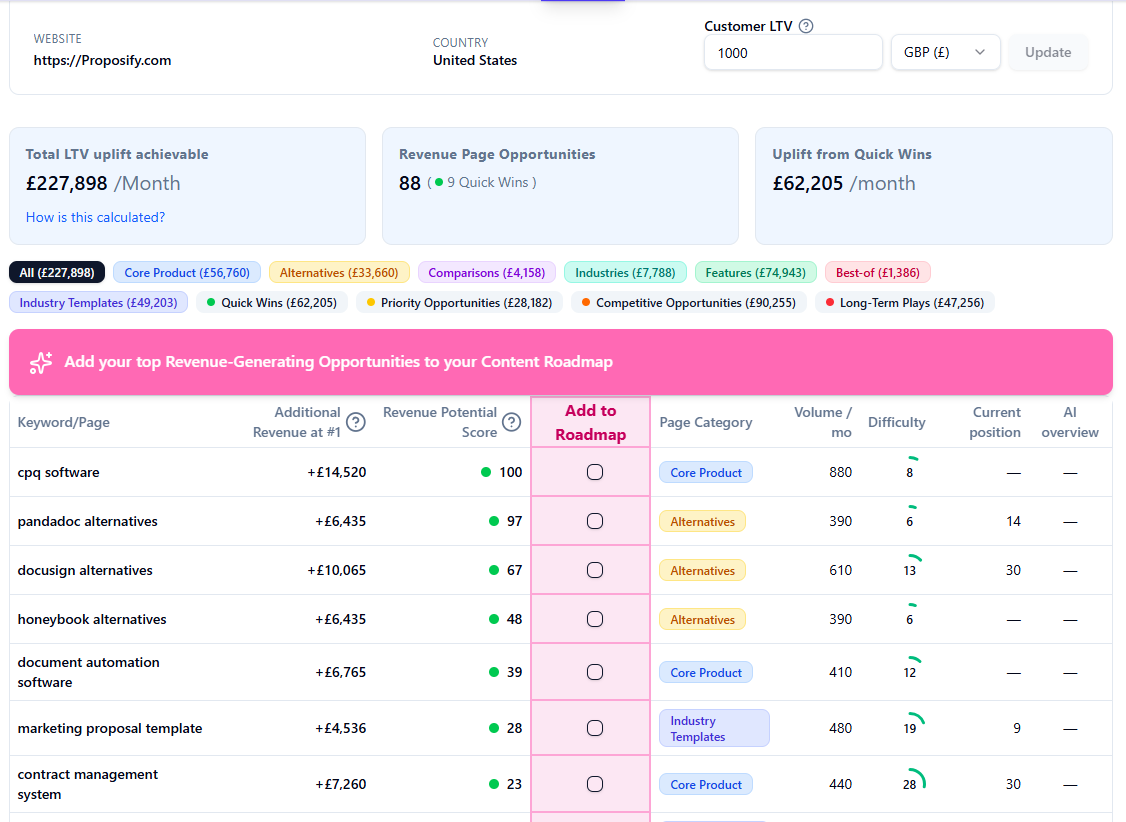
Rather than dumping thousands of keywords into an overwhelming table, it provides a focused list of 30-60 pages the site can build to start generating revenue quickly
It exclusively identifies pages that are likely to have buying intent – things like:
- Competitor alternative pages
- "X vs Y" comparison pages
- Industry-specific pages
- Feature/use-case pages
- Best software/product pages
- Templates
- Core product pages
It then analyses search demand, current rankings, keyword difficulty, likely CTR, conversion potential and your customer value.
From that, it estimates the potential monthly revenue uplift of each opportunity and prioritises them based on commercial value + how achievable the ranking is.
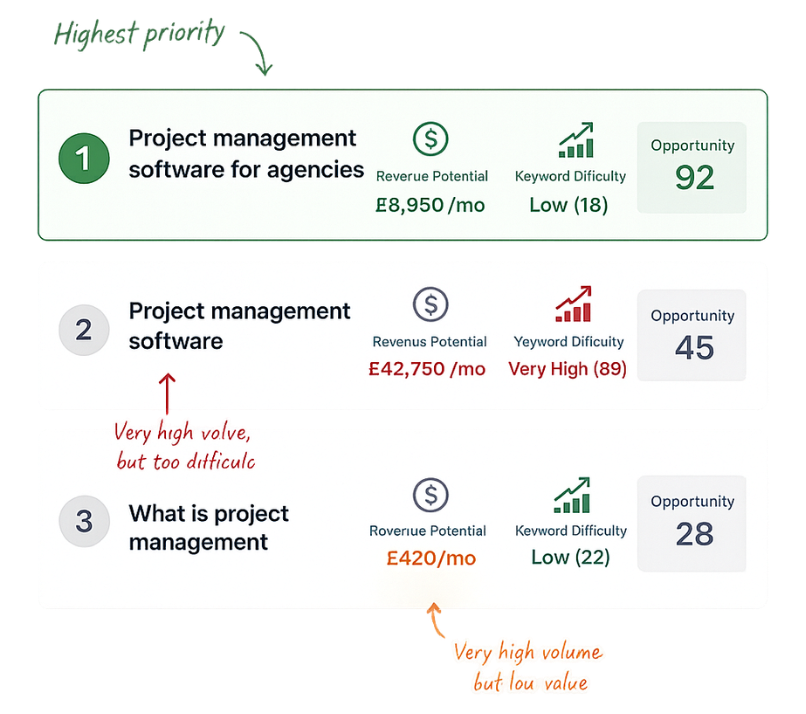
So instead of:
"Here are 10,000 keywords. Good luck."
I've made the output:
"Here are the 30 pages worth considering - and here's how much revenue they could make. These 5 are probably where you should start."
Why I've started with SaaS
At the moment RevPages is heavily focused on SaaS.
Partly because it's a market I know well, but also because the model works particularly nicely for SaaS.
There's usually a relatively clear customer value, plenty of bottom-of-funnel search demand and lots of repeatable commercial page types.
For example, if you're selling CRM software, searches such as:
"Salesforce alternatives"
or:
"CRM for recruitment agencies"
might only have a few hundred searches per month.
Traditional keyword research can make those opportunities look fairly small.
But if a customer is worth £2,000, ranking for a keyword like that could potentially be far more valuable than ranking for an informational keyword with 10x the volume.
That's the distinction I'm trying to surface.
Longer term, I want to expand RevPages beyond SaaS into other industries where organic search has a measurable commercial value.
But I'd rather get it working really well for one market first.
There's also a roadmap + tracking
Once RevPages finds the opportunities, you can add them to an SEO roadmap and plan what you're actually going to publish.
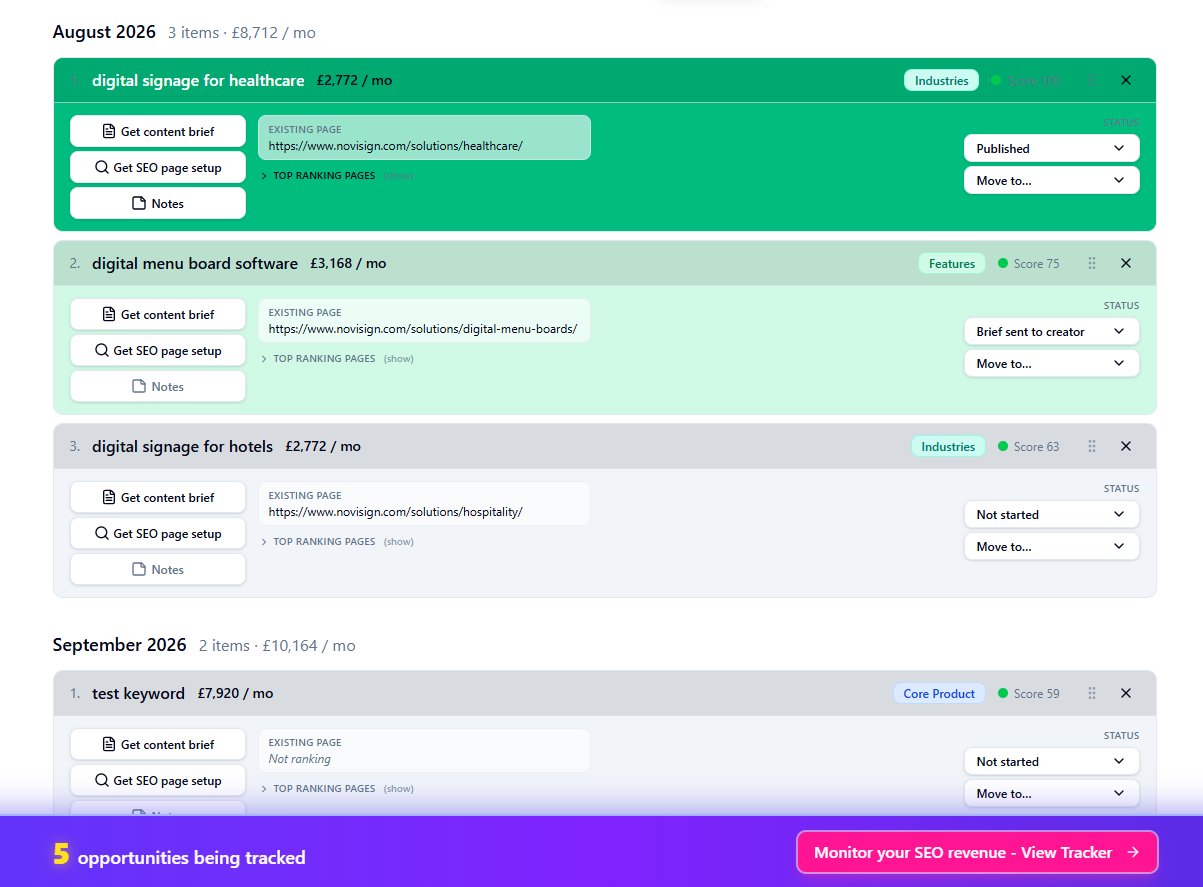
It can generate AI content briefs using the ranking/search data it has already collected, so the idea is to eventually cover the whole process:
Find opportunity → estimate value → prioritise → plan → create → track revenue impact.
I've also just been building out the tracking side.
Rather than getting excited because a keyword moved from position 7 to position 5, RevPages tells you whether that movement actually matters commercially.
It notifies users when an important page is losing several thousands pounds p/month due to a traffic drop, or if a new high-value search term has appeared on the market that could be worth pursuing.
Ultimately I want the main unit of measurement inside the product to be £/$, rather than rankings or traffic.
Where I'm at now
The product is live and usable, but still very early.
Right now I'm much more interested in finding out whether people actually find the outputs useful than trying to perfect every feature.
I've already had some SEO people test it, which has resulted in quite a few changes to the product.
There are also plenty of things I want to add – including more sophisticated revenue tracking, competitor opportunity discovery and eventually AI/LLM search visibility and revenue attribution.
But I'm deliberately trying not to disappear into a cave and build all of those before getting more users.
So now comes the bit I'm less sure about: distribution
My next challenge is getting people to actually discover it.
I've experimented with some LinkedIn ads already. They've generated traffic, but SaaS/SEO audiences on LinkedIn are expensive, so I'm not convinced paid social is going to be the best early acquisition channel.
The slightly ironic plan now is to lean much harder into SEO.
I've started building out the RevPages site around the problems the product solves – SEO revenue forecasting, opportunity prioritisation, content roadmapping, revenue tracking etc.
Next I'll be publishing more useful guides, free tools, templates and calculators around those topics.
I'm also planning to keep doing direct outreach to SaaS marketers and SEO consultants/agencies to get feedback and hopefully find the first group of regular users.
So the rough strategy from here is:
SEO/content + free tools + founder-led content + direct outreach → learn what gets traction → double down on that.
If you're working in SaaS, SEO or content, I'd genuinely be interested to hear whether this is a problem you recognise.
And if you want to try RevPages on your own site, you can run a report here - it's free :) https://revpages.ai

The revenue-per-page framing is the right unit. "Salesforce alternatives" with 300 searches/month and a £2K LTV is worth more than a 5,000-volume informational keyword with 1% conversion. Most keyword tools bury that signal under volume numbers and founders end up optimising for traffic they can't convert.
On distribution: the LinkedIn ads observation is right. SaaS/SEO audiences on LinkedIn are expensive and don't click outbound from ads the way B2C does. The direct outreach to SaaS marketers and SEO consultants is probably your fastest feedback loop right now. They'll tell you within one conversation whether the output matches what they already know they need, which shapes everything else.
One thing I'd add to the roadmap thinking: agencies are a multiplier. One SEO consultant using RevPages on 10 client accounts is worth 10 direct SaaS signups and they have the context to judge the output quality accurately. Might be worth a separate tier or even a white-label angle down the line.
Love the revenue-angle positioning. One gap worth watching: SEO tools still measure clicks, but a growing share of referrals arrives via AI assistants with no click data at all — we built amami.dev to track that layer, the conversation behind the visit. If RevPages factored AI-surfaced demand into its page-opportunity score, it would be ahead of every incumbent.
The strongest next step may be a forecast-to-actual loop, not another acquisition channel. Track each recommended page through three gates: forecasted value, page shipped, and realized conversion value. Then show the forecast error over time by page type. That turns estimated uplift from a static claim into a model that gets more credible with every customer. For distribution, I’d recruit 10 SaaS marketers around a 30-day forecast-versus-actual study and publish the anonymized results. That gives you proof, content, and a reason for agencies to bring client sites.
This is more than just another keyword tool, it has a revenue angle. ~
I discovered that search volume can be a very misleading metric. It may be the case that a keyword with 10k searches is not as valuable as one with 500 searches. If those 500 searches are individuals close to buying, however, it will be much more useful.
I enjoy contemplating the three layers of SEO: Demand, Intent and Commercial Value. The volume indicates high demand. The intent of a person is what they actually want. The commercial value indicates if ranking for a keyword is important for business.
It is easy to skip that final layer of keyword research. Opting to prioritize pages by potential revenue rather than traffic alone seems like a much better way to decide what to build next.
This is a strong positioning angle. Most SEO tools stop at keyword data, but translating that into “which pages could actually drive revenue?” is the part founders and small marketing teams struggle with.
The shift from rankings/traffic to actual revenue potential is the interesting part here. A page with 300 searches can obviously be more valuable than one with 10k if the intent and customer value are completely different. Curious to see how accurate those revenue estimates get once you have enough real-world data.