I built a tool that shows what a contract could cost you before signing
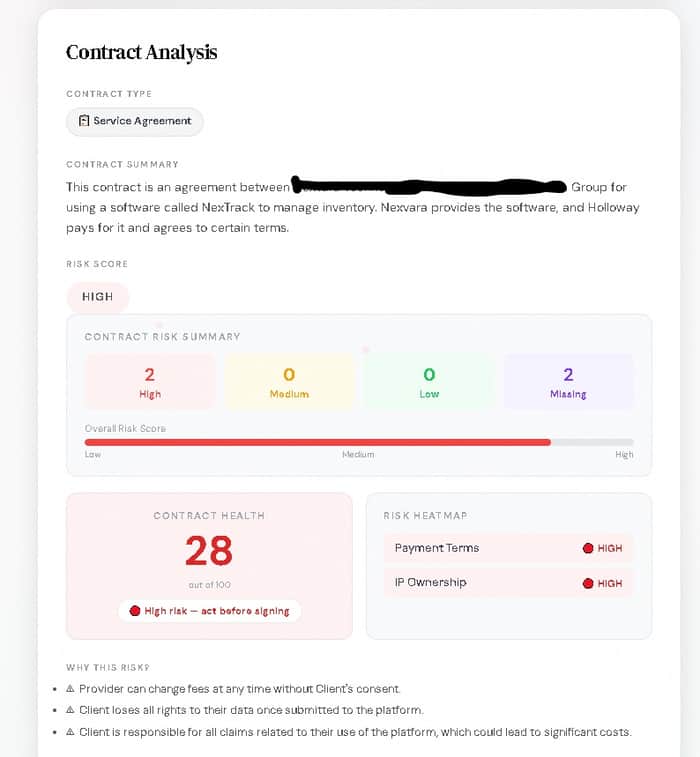
Most founders don’t lose money because they didn’t read the contract.
They lose money because they didn’t understand what was risky.
I’ve been working on something for the past ~7 weeks - trying to make that part clearer.
You upload a contract, and it highlights things like:
– financial risk
– one-sided clauses
– what might actually matter before signing
After going through real agreements (from ~$40k to multi-million deals), one thing keeps repeating:
The biggest risks are usually not obvious.
One example:
I looked at a multi-million partnership agreement that seemed fine at first — but control and exit terms were heavily skewed toward one side.
What’s been interesting is how people use it:
not for “analysis”, but right before signing - asking:
“is this safe?”
If you’ve dealt with contracts before, I’d be curious what you think.
You can try it here:
https://joyful-granita-8415bc.netlify.app/

This is a brilliant use case! As a non-technical solo founder building an AI platform, I really appreciate tools that simplify complex logic for users. Contracts can be a nightmare, and estimating costs beforehand provides massive value. Congrats on the launch and the traction!
Appreciate it
This is amazing, congrats!!
If you can consistently surface that in a simple way, this could be very very useful. Especially for founders dealing with bigger deals without having legal support on every step! Like me, lol
I'm gonna check it out!
Have an amazing start of the week!
Appreciate it 😄 let me know what you think once you try it!
Have a great week too!
The framing shift from "what does this say" to "what does this cost" is where the value actually is. Most contract tools tell you what the clauses mean. Fewer actually quantify the exposure. The difference matters a lot to someone who isn't a lawyer and is trying to make a business decision, not a legal one.
The use case that jumps out to me is freelancers and small agencies who sign service agreements regularly and have no legal counsel in their corner. They usually just skim, hope nothing bad is in there, and sign. Having something surface "this auto-renews for 12 months with a 90-day cancellation window and the penalty clause here could cost you approximately X" before they put their name on it is genuinely useful.
One question worth thinking about: what happens when two parties both use the tool on the same contract and get different risk scores? That's probably an interesting edge case for where the tool's perspective sits.
Yeah, it can vary - different inputs can lead to different outputs, especially since it’s not just one user or one context.
My gratitude goes out to the entire team of Revox Credit repair. Someone left information REVOXCREDITREPAIR at GMAIL dotCOM under a comment section on helping to repair credit. I was interested in knowing more and if the hacking team still does this. I had poor credit, an old bankruptcy and problems with getting approved for an apartment due to 2 broken leases from the past which I explained to Revox Credit Repair when I made contact with them. They cleaned my credit records and they boosted my credit score within just few days of contacting them.
The framing of "they didn't understand what was risky" over "they didn't read it" is a strong product insight. Most tools in any space assume the user's problem is access to information. Usually the real problem is interpretation.
I'm building in a completely different space (personal finance) but the pattern is identical. People don't fail with money because they don't have transaction data — their bank app shows them every purchase. They fail because nobody translates that data into "here's the one thing that's quietly costing you more than you realize." The interpretation layer is where the value lives, not the data layer.
Your observation that people use it right before signing — asking "is this safe?" rather than "analyze this" — says a lot about positioning. The use case isn't analysis. It's confidence. That's a much more emotional and compelling angle to lead with in your marketing.
are you finding that users come back with multiple contracts, or is it mostly one-time use? That'll shape whether your growth comes from retention or referrals, which is a pretty different playbook for each.
Yeah, that’s been interesting to see - still early, just observing how it develops.
This is a smart angle. “What could this contract cost me?” is much easier for founders to act on than a generic legal summary, especially right before signing when time and attention are limited. I also like that you’re grounding it in real agreements instead of treating it like a theoretical risk checker. Have you noticed whether users care more about the dollar impact, the risky clauses themselves, or just getting a quick yes/no confidence check before they move forward?
Still early - not sure yet, just seeing how it plays out.
This is a genuinely useful tool - contract risks are one of those things that seem obvious in hindsight but are easy to miss in the moment. The "right before signing" use case is smart positioning.
I like that you focused on financial risk and one-sided clauses - those are the gotchas that hurt small businesses most. Have you considered adding a feature for simulating "what if" scenarios? Like showing how much a termination clause could cost if triggered?
That’s a good idea - appreciate it.
Interesting wedge. The best part of the product is the moment right before signing when someone asks “what could actually hurt me here?” I’d lean harder into that than “AI contract review.”
A few concrete tests:
If useful, I can do a brutally specific $1 teardown of the landing page / first-upload flow and mark up the exact sections I’d rewrite: https://dailo.com.au/roastmysite?source=external_manual_ih_vidi_contractrisk_apr15_usd_presell_hv
Appreciate the suggestions - will think through it.
Interesting niche. The "hidden cost" angle is smart because it reframes contract review from a boring compliance task into a financial decision - which is how founders actually think.
I'm curious about the data model here. Are you building up a dataset of common contract gotchas over time? Because the real value compound would be: the more contracts analyzed, the better your risk benchmarks become. Like "this auto-renewal clause is in the top 10% most aggressive we've seen."
What's been the main objection from early users - is it trust ("I don't want to upload my contract") or skepticism about the accuracy?
Still early - just seeing how it evolves for now.
Fair, the "watch and learn" phase is underrated. One thing worth instrumenting early though: which clauses users skip past during review. The ones they don't pause on are usually the ones that burn them later. Aggressiveness ranking is valuable, but attention drop-off by clause is the leading indicator.
Good luck with the build.
thanks
This is inspiring, I just started my own journey today
Nice, good luck with it 🚀
This is a great insight — "the biggest risks are usually not obvious." That's true in contracts and honestly in almost every financial decision. People focus on the headline number and miss the fine print that actually costs them.
I'm building something in a completely different space (crypto purchasing power) but ran into the same pattern — people stare at the Bitcoin price and miss that inflation is quietly eating their real returns. The hidden cost that nobody reads the fine print on.
Curious about your approach: are you using AI to flag the risky clauses, or is it rule-based? The "is this safe?" framing is smart — that's how normal people actually think about contracts, not "analyze this for legal compliance." You nailed the UX angle.
How are you thinking about monetization? Per-contract fee, subscription, or freemium?
Appreciate it - still early, just testing different things for now.
This is a really valuable problem to solve. The “is this safe?” use case before signing is especially smart — that’s exactly when the stress is highest and clarity matters most.
Curious — how well does your tool currently handle subtle power imbalances or long-term relationship risks (like non-compete, IP assignment, or automatic renewal traps)?
Those seem to be the ones that quietly cause the most pain down the line.
Congrats on shipping this after 7 weeks — looks like a genuinely useful tool.
Appreciate it - still early, just seeing how different cases come through so far.
This is a really strong use case, that “is this safe?” moment right before signing is exactly where something like this matters.
One thing I’m curious about:
Right now, after someone gets the analysis, do they actually act on it?
Like renegotiate, question clauses, or share it with someone else?
Feels like there’s an opportunity to extend that moment a bit, not just “here’s the risk”, but guiding them into:
– what to question
– how to respond
– or even letting them simulate “what happens if I sign this vs push back”
I’ve been working on something where tools like this become more of a guided flow instead of a one-off output, especially for high-stakes decisions like this.
Might be interesting to test, since your users already come in with strong intent.
Curious what you’ve seen so far, do people treat it as a final check, or actually use it to make decisions?
Still early - just seeing how people use it in different situations so far.
Yeah that makes sense.
Feels like the key moment will be what people do right after seeing the risk whether they act on it or just move on.
If you start seeing people ask “what should I do next?”, that’s probably where the real opportunity opens up
Yeah, that’s something I’m keeping an eye on.
Yeah that’s a really strong signal.
Once people start asking that, it’s basically shifting from ‘analysis tool’ to ‘decision tool’.
That’s where it gets way more valuable
Yeah, starting to feel that.
Love the positioning. Highlighting risk > just explaining clauses. Curious though, how do you avoid false positives or over-warning? Feels like too many ‘risks’ could make users ignore the signal.
Yeah, that’s something I’m still figuring out - early days, just seeing how different cases come through.
The trust problem you describe extends past the signing moment. Even with a solid contract, disputes about what was actually approved are surprisingly common once work is underway — and there's usually no paper trail for the execution side.
Two separate trust gaps: the contract risk before signing (what you're solving), and the approval proof during execution. Both are real, and both expensive when they go wrong.
Building something for the ongoing approval side (proofsent.com) — the contract-before and the proof-during feel like natural complements for anyone doing long-term client work.
Yeah, that makes sense - both sides of that show up in practice.
This feels like one of those products where the real value isn’t in “analyzing documents” but in reducing decision anxiety at high-stakes moments.
Most founders don’t avoid legal mistakes because they’re careless — they make them because risk is buried in language they technically understand but can’t properly evaluate.
I think framing it around “Is this safe?” is a huge insight because that’s the actual job users are hiring the product for. They’re not buying analysis; they’re buying confidence before commitment.
Curious — have you found users care more about identifying specific red flags, or do they mainly want an overall trust/risk score before diving deeper?
Still early - seeing a mix of both so far.
This is really interesting — especially the point about risks not being obvious.
Curious, how are you handling edge cases where context matters a lot (like negotiation history or verbal agreements)?
I’m working on a tool in the freelancer space and seeing a similar pattern — people don’t just want analysis, they want quick confidence before making a decision.
Would love to know what kind of feedback you’re getting from early users.
Yeah, that’s a tricky part - still early, so just seeing how different cases come through for now.
I love learning the true tale of how something was built, especially the choices that aren't immediately apparent. When working on this, what was the biggest obstacle you didn't anticipate?
Honestly, just figuring things out as I go.
Interesting perspective — especially the part about distribution.
Curious: what channel worked best for your first users?
Mostly just conversations so far.
Most founders don’t lose money reading contracts — they lose it misunderstanding risk.
Building something that highlights financial risk + one-sided clauses before signing.
Also, there’s a comp live — $19 entry, winner gets a Tokyo trip. Just opened.
Tokyolore.com
This is a lifesaver for founders. I’m curious, do you think this could be applied to Sales Service Agreements specifically? I’m currently building an outreach automation tool (AutoSales) and my users often struggle with the fine print in agency contracts. Would love to hear your thoughts on that niche!
Yeah, could be relevant there too.
I’ve sent you a connection request on LinkedIn — would love to connect and explore this further!
Just accepted - nice to connect.
This is very interesting, and I see a utility for freelancers as well.
May i know if it can help freelancers assess the risks of the contract? ( i am skeptical if it is trained for >$40k contract values).
Also is it like a model which has been trained on multiple agreements, where it is told x should be flagged and y is ok? How does this work
Yeah - a lot of the contracts coming through already are in that range and higher.
Boa ideia
Obrigado!
Spot on — the biggest risks are rarely the obvious ones. I've seen the exact same pattern, but with business systems instead of contracts.
As a consultant who's done 20+ years of system analysis, I spent the last year building a SaaS platform that does the same for organisations: uncovers performance risks that explain why a company can't deliver what leaders need.
Like your tool, it's not about generic analysis — it's about surfacing the hidden constraints right when decisions get made (scaling blocks, delivery failures, capability gaps).
The resonance for me is identical: founders don't fail because they lack ambition, but because the system underneath isn't set up for it.
Curious if you've seen overlap between contract risks and operational system risks? Would love thoughts from anyone building in this space.
Yeah, there does seem to be some overlap there.
That “is this safe?” framing is brilliant. Founders usually are not looking for a full legal analysis. They want a fast, practical gut-check before they sign. That is a very different product from “legal AI,” and I agree most tools seem to miss that distinction.
My honest question is about the trust gap.
I have friends who signed 30+ contracts — payment processors, cloud vendors, APIs, and similar agreements — and the clauses that felt most dangerous were rarely the obvious ones. It was usually something buried deeper: indemnification language a few pages in, a liability cap hidden in a schedule, or some subtle wording that only a good lawyer would catch.
So how do you handle that?
If the tool misses something important and a user gets burned, they are probably going to blame the tool, not themselves. That feels especially tricky when the product promise is basically, “Should I sign this?”
Do you handle that by leaning heavily on educational framing and disclaimers? Or do you take a stronger approach, where the product clearly says, “We flag these categories of risk, and we do not cover these other areas”?
Yeah, that’s a fair point - the trust side is definitely the hardest part.
Feels like it’s less about covering everything and more about being clear on what’s actually being surfaced vs what isn’t.
Agreed, reading the finer details while signing a contract are always left out.
Yeah, that’s true - details like that often get overlooked.
yeah that’s actually where people get burned, not the obvious stuff but the little clauses buried in there… termination, liability caps, payment terms, that’s where it bites later, tool sounds useful if it flags real risks and not just highlights random legal jargon, but I’d still never trust AI alone on anything big, more like a second pair of eyes before a real lawyer, not a replacement
Yeah - it’s usually those smaller clauses that end up mattering most later.
I think it depends on how reliable the output actually is.
I actually love that framing. ~
That's the key I think. So many tools just provide the "what the contract says" without ever addressing the real fear – "what could come back to haunt me".
The "is this safe?" approach seems so much more relatable.
And maybe that's why they're using it just before they sign, and not far earlier. It's that pre-committal safety check. In fact I'd lean into that even harder and position it as less of a "tool" and more of a second opinion.
The equivalent of "sanity check before I sign and it all goes wrong".
Curious as to whether you considered showing more concrete consequences?
Not just "these terms are risky" but maybe "based on these terms, you could be liable for $X if event Y occurs".
I feel like that's more memorable.
Overall though, I think this is one of those ideas where positioning is paramount. It's got massive potential as is.
Appreciate this - especially the “second opinion” framing.
The point about showing concrete consequences is interesting, makes it feel much more real.
Love the framing here — people don’t lose money by not reading, but by not understanding.
That’s painfully accurate. Curious how you’re defining/quantifying “risk” under the hood?
Yeah, that’s the tricky part - still figuring that out.
This hits home, Meirambek! 🛡️
I'm doing something similar for the "Design/Trust" side with RoastMyLanding. After 96 audits this week, I've realized founders are just as "blind" to their own landing page flaws as they are to risky contract clauses.
The shift from "analysis" to "Is this safe?" is a massive insight. People don't want more data; they want peace of mind before they hit "publish." Great concept, keep building!
Appreciate it - that’s a great parallel. 👍
This is really thoughtful! I like how you’re focusing on the real problem founders face, not just reading contracts, but actually understanding the hidden risks before signing.
That shift from “analysis” to “is this safe?” feels very smart and practical.
The concept of uploading a contract and getting clear risk highlights sounds genuinely useful.
One thing that stood out to me though: the value really clicks after reading your post here, but it might not come across as strongly in those first few moments when someone lands on the product. That feeling of “here’s what actually matters before you sign” is powerful, but I’m not sure it lands immediately.
Really strong direction overall, it feels very human and solves a painful problem.
I’m genuinely curious how you’re thinking about making that clarity hit faster in the first experience, would love to hear your approach.
Appreciate it - yeah, I’m working on that.
You’re welcome. Happy to take a closer look, if you’d like. No pressure at all.
this is a problem a lot of service business owners run into, honestly. the contract stuff is just one layer though. another one we kept hitting was communication, clients texting founders directly with no visibility for the rest of the team. been working on that exact problem too. love seeing tools like this that fix the real friction points before they become expensive mistakes.
Appreciate it 🙌
this insight about the "right before signing" moment is spot on. That's when people actually need help, not during some theoretical review weeks earlier.
we see the same pattern with SaaS tools. founders spend weeks researching platforms but make the final decision in 10 minutes based on pricing page clarity. timing matters more than depth sometimes.
the buried risk thing is universal. it's never the obvious clauses that get you. always something like auto-renewal terms or liability caps that seemed harmless at first glance.
Yeah, timing really seems to be the key moment.
This is a real problem and you've nailed the insight. Most founders skim contracts looking for obvious red flags but miss the structural ones buried in control and exit clauses.
Curious to know how are you handling the nuance between "this clause is risky" vs "this clause is risky for your specific situation"?
A one-sided exit clause means something very different for a bootstrapped founder vs a VC-backed one.
That context layer seems like the hardest part to get right.
Yeah, that context piece is definitely tricky.
This is actually super useful. People often overlook the hidden costs until they’re locked in. How are you calculating the risk or uncertainty in contracts?
Good question - still something I’m thinking through.
This is really cool, feels similar to a problem I’ve been seeing on the revenue side.
A lot of SaaS founders don’t realize they’re losing 5–9% of MRR to failed payments until it’s too late.
Interesting how many “invisible costs” exist in SaaS.
Yeah, exactly - it’s usually not obvious upfront.
Only shows up later when it’s already impacting things.
Yeah exactly, by the time it’s visible, you’ve already lost a chunk of revenue.
Out of curiosity, have you ever checked how much you're losing from failed payments?
Yeah, seems like one of those things people only notice later.
this is such a smart use case. service businesses especially get burned by contract terms they didn't fully internalize before signing. a travel advisor friend of mine once had a client dispute that came down to a single clause about payment timelines that neither party had really focused on. a tool like this at the moment of signing is exactly the right timing. curious whether you're targeting a specific vertical or going broad initially.
That’s a great example - amazing how often it comes down to one small detail.
Still figuring that part out.
Excellent idea. But I want to know how you managed the context. Some AI models are not capable of analysing and remembering the bad points, especially if you upload a contract that is 100s of pages long. It deviates easily. So, wondering how you managed it.
Yeah, longer contracts can definitely get tricky.
This is one of those problems where you don't realize how much it matters until you've been burned by it. I signed a SaaS vendor agreement last year that had an auto-renewal clause buried in paragraph 14 that locked us in for another year before we even noticed. Would've been nice to have something flag that before I signed.
Curious about the UX - when someone uploads a contract, how quickly does the analysis come back? And do you highlight the specific clauses inline or is it more of a summary report? I think the inline approach would be killer for people who are skimming contracts right before a deadline (which let's be honest is most of us).
Totally. Especially auto-renewal clauses and liability caps buried in the fine print. Tools like this that surface the risky parts before you sign are such a smart approach.
Yeah, that happens more often than people expect.
This is really useful. I feel like a lot of people sign contracts without fully understanding the risks this could save people a lot of money.
Appreciate it - glad it resonates.
"The biggest risks are usually not obvious" — this is exactly right. Most people skim contracts looking for obvious red flags, but the dangerous parts are buried in exit clauses and liability caps.
Smart to focus on the "is this safe?" moment right before signing. That's when people actually need help, not during a theoretical review.
Yeah, exactly - those parts tend to matter way more than the obvious sections.
this is cool. I wonder how this works exactly. Does it analyze the wording and there's an algorithm in the background that determines the risk based on one sided clauses etc?
Still early, but the goal is to surface where something might be one-sided or risky.
This is interesting — especially the “right before signing” use case.
Feels like that moment is less about analysis and more about confidence / reassurance. Almost like people want a second brain to sanity-check what they’re about to commit to.
Curious — have you seen people hesitate because of trust (like relying on it for something high-stakes), or are they pretty quick to use it once they land there?
Yeah, I’m starting to see something along those lines.
Yeah — that’s exactly what it feels like.
From what I’ve seen, people don’t hesitate much if the experience feels trustworthy in that moment.
It’s less about validating every detail and more about getting that quick “okay, this looks solid” signal before committing.
I think the bigger drop-off probably happens earlier — like if something feels even slightly off (UI, wording, clarity), people might not even reach that “right before signing” moment with full confidence.
Curious — are most people coming in already somewhat confident, or are they using it to resolve doubt?
Good question - I haven’t looked into that deeply yet.
Yeah, that makes sense — it’s one of those things that’s easy to miss early on.
I feel like for something like this, trust actually starts forming before people even use the tool properly.
Like if the product already feels reliable from the outside (name, positioning, how it presents itself), they come in with less resistance.
Otherwise they’re kind of using it while still subconsciously questioning it.
Might be worth observing where that first impression is helping vs hurting — especially since your use case is so close to real money decisions.
Yeah, that makes sense - trust probably starts forming before people even use it.
Yeah — exactly.
That “before they even use it” layer is underrated.
Out of curiosity — are you fully set on the name already, or still treating it as something that can evolve as the product matures?
Still figuring things out.
Yeah — just thought it matched the trust/risk side of what you’re building a bit better than something more abstract.
Either way, I think you’re right to keep the naming side open this early — for a product like this, first-impression trust does a lot of work.
If you do end up exploring alternatives more seriously later, happy to throw over a couple more thoughts.
Makes sense — that’s actually a good place to be early on.
For something like this, even a slightly more solid / trustworthy-sounding name can change how people feel about it before they even try it.
One that came to mind from my side is Vroth.com — short, strong, and feels a bit more grounded for something dealing with decisions and risk.
Not pushing it, just sharing since you mentioned you’re still exploring.
Appreciate it - interesting suggestion.
this is great keep going, also depending upon the type of contract what is essential should be given as a reference because most of the time the problem comes from the fact that neither party pays attention to the details which results in scope creep later, also an Advisory section would be great too
That makes sense - a lot of issues seem to come from things people don’t pay attention to upfront.
I have also developed a wonderful browser game that is famous for it's own you can try it as well
Appreciate it - trying to keep this thread focused on contracts and risk for now.
Interesting angle!
In my experience, the risk often comes from what's missing in the contract. Have you considered building detection for absent clauses, and if so, how would you tackle that?
That’s a great point - I’m starting to see that as well. Missing clauses can be just as risky as what’s written, still figuring out the best way to surface that clearly.
Coming from fintech, I’ve seen how the real risk is almost never in the obvious clauses — it’s always buried in edge cases like exit terms, liability, or control
Yeah, exactly - it’s almost always in those edge cases, not the obvious parts.
this is a real problem
from business side - most mistakes come from “looks fine” contracts
what you’re building makes sense, especially before signing
keep going 👍
Appreciate it - that’s exactly the kind of situation I’m trying to catch before signing.
Makes sense 👍
Curious - what’s the hardest part when reviewing a contract before signing?
for me - understanding what it actually means in real life, not just legally
a lot of things look fine on paper, but the risk shows up later
Yeah, exactly - that gap between “looks fine” and real impact is what I’m seeing a lot.
This comment was deleted 5 months ago