I built a location-aware social platform as a solo founder - now I need real feedback
Hey Indie Hackers,
I’m Fotios, a solo founder and Creative Technologist from Greece.
Over the past months I’ve been building Wedbeas, a location-aware social discovery platform designed around one idea: helping people connect not only with people nearby, but also with places they’re visiting or considering moving to.
I wanted something that sits somewhere between social discovery, local communities and relocation tools — without simply becoming another generic social network.
So far I’ve built and shipped features including:
Local and Traveller modes
Location-based discovery and radius search
Profiles, likes and matches
Real-time chat
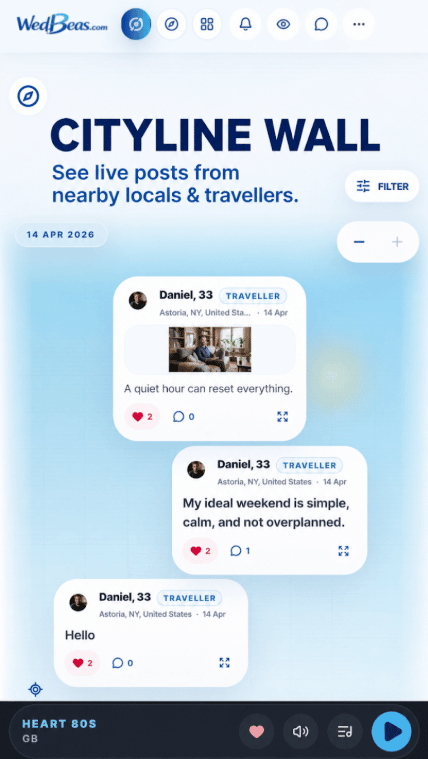
Social posts, comments and reactions
City-based feeds
Maps and location-aware features
Relocation-oriented tools
Shared music listening inside chat
Web + Android versions
I’ve been building it mostly solo using an AI-assisted development workflow, with React, TypeScript, Supabase and a lot of rapid prototyping, testing and iteration.
The technical side is not the biggest question for me anymore.
The big question is: would people actually want this?
I’m now at the stage where I need people outside my own circle to use it and tell me what feels useful, confusing, unnecessary or missing.
I’m especially interested in feedback on:
Is the core idea immediately understandable?
What feature would make you come back regularly?
Would you use something like this before travelling or relocating to another city?
What would stop you from signing up?
I’m not looking for polite feedback — I’d rather hear what doesn’t work.
Wedbeas: https://wedbeas.com
If anyone here is also building a social/community product, I’d love to compare notes on getting the first real active users without spending heavily on ads.
Thanks!

I think the strongest use case might be the moment before someone moves somewhere new. “I’m moving to Athens next month and know nobody” feels like much stronger intent than just “show me people nearby.”
Have you tested onboarding around destination + moving/travel date instead of location alone? Curious whether people engage more before they arrive or once they’re already there.
The honest problem with location-based social isn't the product, it's density: in a city with 8 signed-up users the experience is empty, and empty kills retention before any feature can help. If I were you I'd stop asking "would people want this" globally and pick one city plus one narrow persona — say newly relocated expats in Athens — then hand-recruit 50 of them from existing Facebook/Reddit relocation groups and refuse to open other cities until that one feels alive. Seed it manually too: run a weekly real-world meetup or a "who's new here this week" thread yourself for the first two months, because early social apps are operated, not launched. On the feedback questions, the one that actually predicts survival is not "is the idea understandable" but "did a user come back on day 7 without a notification" — instrument that and you'll learn more than a hundred survey answers. I'd also cut shared music listening for now; it's charming but it's a retention feature for an app that doesn't yet have anyone to listen with. One last thing: ask your first 20 users what they were doing instead of your app, and you'll find the actual competitor is usually a WhatsApp group.
I am Chinese, but I can't find my city in your website, so I can't go on next
I'd disable half the extra features for now and focus 100% of your onboarding on the "Local vs Traveler" connection to see if people actually start conversations.
Your first question is testable, so I tested it: I opened wedbeas.com cold and wrote down what the page told me, before re-reading your post.
What the home page says: a skyline of world landmarks, the words LOGIN, MATCH, CHAT, TRAVEL, SETTLE arcing across it, the headline "CONNECT ACROSS CITIES. MEET WITH INTENTION.", one button (LOG IN / SIGN UP), then a section titled "SERIOUS CONNECTIONS ONLY" about a "more serious, respectful, and meaningful way to connect online." Under a brand that starts with "Wed", match + meet-with-intention + settle reads as an intentional-dating app.
What your post here says: locals and travellers, city feeds, local communities, relocation tools. Almost none of that vocabulary is on the home page - the only "community" is the Community Guidelines link in the footer. The whole page is about 550 characters of text: hero, the serious-connections paragraph, footer. So on your first question: the page isn't just unclear, it's clearly communicating a different idea than the one you described in this post.
The odd part is your About page already has the fix. "a city-based social connection app for locals, travellers, and people starting a new chapter in a new city" is the actual idea in one sentence, and "Moving across the world should not mean moving alone" is a stronger headline than the one currently on the hero. That copy is sitting one click away from where every stranger lands.
What would stop me from signing up (your fourth question): the only door on the page is log in / sign up, and nothing of the product is visible before it - no screenshot, no example city feed, no map. I'd be committing before seeing anything. And if I'd come for the relocation side, "SERIOUS CONNECTIONS ONLY" reads like a sign that this place is for a different visitor.
One data point for the three-products observation above: right now the browser tab says "City-Based Social Connections", the home page says intentional dating, and this post says discovery plus relocation. Three surfaces, three pitches. Whichever product you pick, the home page is where the pick has to show up first.
The feature list here is honestly the concern, not the tech - you've shipped chat, feeds, maps, relocation tools, shared music, matches, web and Android, all before finding out if the core loop works. That's a lot of surface area to maintain feedback on at once. If I were narrowing it down I'd temporarily kill everything except one mode (my guess is local, for the reason the other commenter gave: travel has a built-in expiration date that ends the habit) and ship that alone to 20 real people in one city. Right now feedback on "the whole platform" is going to be diffuse and hard to act on - feedback on one sharp feature is something you can actually decide to keep or cut. What's the single feature people have organically used the most without you prompting them to?
Solo builder here too, also past the "does the tech work" stage and squarely in the "will anyone actually want this" stage — so this resonates a lot.
On your question about first real users without ad spend: I'm currently testing direct outreach to a narrow, specific audience (people who already show clear intent for the exact problem I'm solving) rather than broad posting, and it's slower but the signal feels more honest — fewer polite "cool idea!" reactions, more actual silence or actual follow-up questions, which is the contrast I actually want to see.
Question back on Wedbeas: of "local mode" vs "traveller mode," which one are you finding pulls people back more? My guess would be traveller mode has a natural expiration (the trip ends) while local mode needs an ongoing reason to open the app — curious if that's matched your early usage or if it's the opposite.
Happy to compare notes on the outreach side if useful — direct message works for me.
You’ve built a lot around the location layer, so I’d be less interested in whether each feature is useful individually and more in whether people immediately understand the one reason to use Wedbeas.
That distinction could affect both sign-up and repeat usage.
The fact that you've shipped this much as a solo builder is impressive. But "would people want this" is actually the measurement question most builders skip - they measure features shipped and months of work. You measured the output correctly (lots of features) but the hard part is measuring the boundary: what specific outcome does each person join for, and are they coming back for that. When you measure what people are actually trying to solve (moving to a new city? making local friends? finding places?), you find three different products inside one app. Most location platforms die here - they try to be everything. The ones that work pick one measurement: "did they find what they came for?" and strip away everything else.