Gaining an $11M ARR foothold by taking on an outdated
incumbent

Working at a Silicon Valley startup, Sean Mallapurkar saw how advanced software could be — and he saw how outdated the software in his dad's industry was. So, they teamed up to build a niche CRM.
Nine years later, Recruit CRM is bringing in $11M ARR.
Here's Sean on how he did it. 👇
A father-son duo
I’m Sean Mallapurkar, the cofounder and CEO of Recruit CRM.
I grew up around recruitment businesses — my father spent decades in the industry (Randstad, ADP), so I had a front-row seat to how agencies operated. After graduating early from Indiana University’s Kelley School of Business, I moved to the Bay Area and worked on a venture-backed startup. That experience was valuable, but it also made me realize I wanted to build something more durable and capital-efficient.
In 2017, my father and I started Recruit CRM.
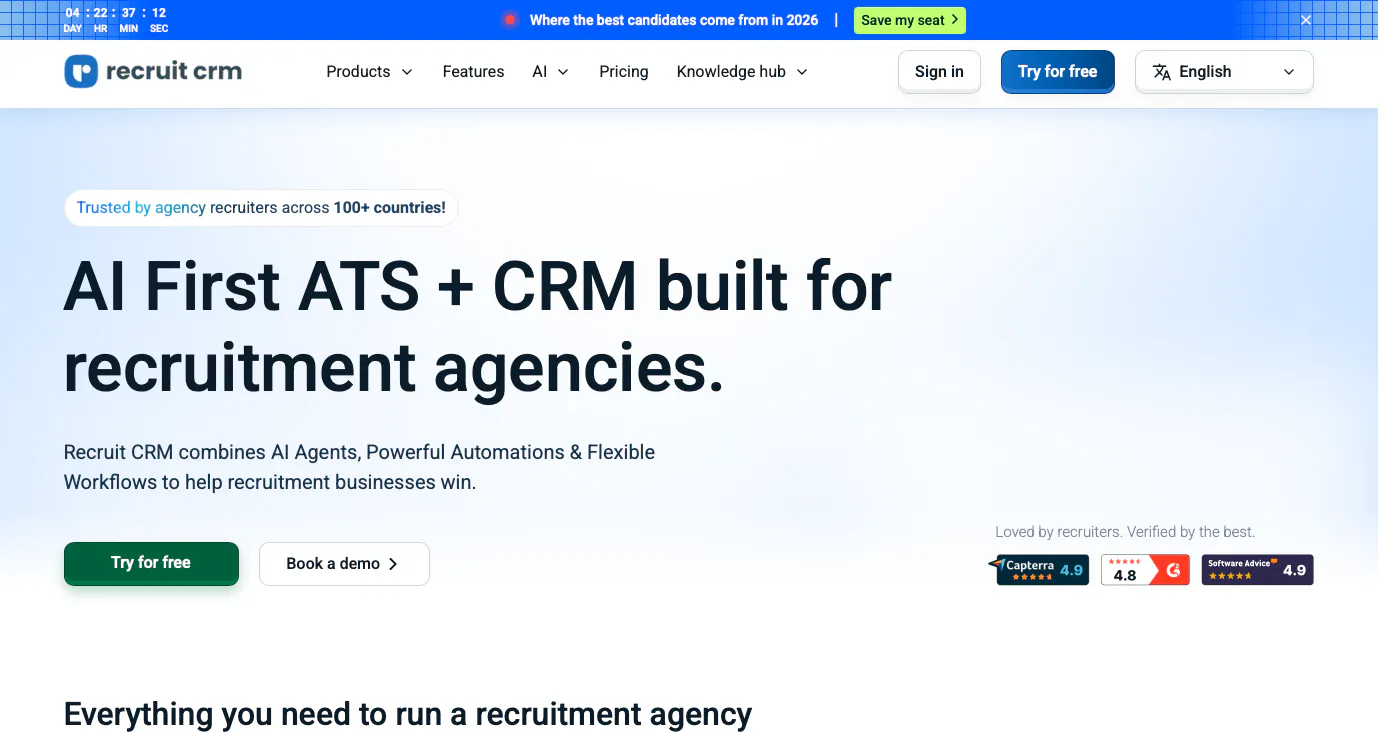
Today, Recruit CRM is a SaaS platform (ATS + CRM) for recruitment and executive search firms. We’re fully bootstrapped, and we hit our first million in early 2021. Now, we're generating nearly $11M ARR, growing ~40% YoY, and maintaining ~40% free cash flow margins. We serve ~2,000 recruitment firms across 100+ countries, with most of our customers in the US and Western Europe.
Our focus is simple: helping recruitment agencies make more placements with less effort. That means everything from candidate tracking and client management to workflow automation, reporting, and integrations.
Finding the gap
I understood the industry well early on. I always noticed how critical software was to my dad's day-to-day operations — yet most of it felt outdated and clunky.
When I later worked on a venture-backed startup in the Bay Area, I saw what “modern SaaS” could look like — great UX, fast iteration cycles, customer-driven development. The contrast was stark. Recruitment software hadn’t evolved at the same pace.
That’s where the idea for Recruit CRM came from.
We saw an opportunity to build a modern, easy-to-use ATS + CRM specifically for recruitment and executive search firms—something that made recruiters more productive instead of slowing them down.
Another big motivator was how we wanted to build the company itself. We deliberately decided to bootstrap. We didn’t want to optimize for vanity metrics or burn — we wanted a profitable, durable business from day one.
So it wasn’t just “there’s a gap in the market.” It was also "we understand this customer deeply, the product category is behind, and we can build a better, more sustainable company while fixing it."
Building in the early days
In the early days, we were scrappy and customer-driven. We spent less than $70,000 to reach our first dollar of revenue in 2018.
We didn’t start with a grand product vision or a big team — we started by talking to many recruitment agencies. Because of my dad’s background, we directly accessed real users from day one. We spent significant time understanding how recruiters worked — how they tracked candidates, managed clients, and where existing tools like Bullhorn fell short.
We built the initial product to solve a few core workflows effectively:
Managing candidates and clients in one place
Tracking the recruitment pipeline (jobs, submissions, placements)
Making it fast and intuitive to use day-to-day
We deliberately kept the scope tight. No bloat, no “enterprise checklist” features — just something a recruiter could pick up quickly and enjoy using.
On the execution side, a small team, mostly engineers in India, iterated fast. We’d ship something, get feedback from a handful of customers, and refine it almost immediately. We didn't have a long roadmap — it was more like a tight feedback loop.
We got one thing right early: charging from the beginning. Even when the product was basic, we didn’t position it as a free tool. That forced us to build something people genuinely found valuable, not just “nice to have.”
A pragmatic tech stack
We’ve kept the tech stack pragmatic — nothing overly fancy, just things that let us move fast and scale reliably.
On the backend, we primarily use PHP with a Laravel-based architecture. On the frontend, we use a mix of JavaScript frameworks (we’ve evolved over time as the product has grown). We host our infrastructure on Amazon Web Services, with most of our core data in the Ireland region.
We also run read replicas in multiple regions (like the US and India) to keep the product fast for a global customer base. Performance matters a lot for us because recruiters live inside the product all day — it’s not something they use occasionally.
A big part of our “stack,” beyond just languages and frameworks, is how we think about building:
We optimize for speed of iteration over perfection.
We avoid over-engineering early.
We invest in stability and performance as we scale.
We’ve also built a robust API layer, which allows integrations with various third-party tools—email, job boards, sourcing tools, etc.—since recruitment workflows are ecosystem-heavy.
At our stage, the stack is less about the specific technologies and more about a system that lets ~150+ people ship consistently without breaking things.
A straightforward SaaS
Our business model is straightforward SaaS.
We charge recruitment agencies a per-user, per-month subscription fee to access Recruit CRM. Pricing scales with the number of users and feature tier, so we grow with our customers. Most of our customers are small to mid-sized recruitment and executive search firms, typically 1–200 recruiters.
We also keep things clean — no services-heavy model, no complicated contracts. High-margin, recurring revenue focused on long-term retention.
Overcoming challenges
It hasn't been without challenges. Here are a few:
Building a global company from day one: Our customers are primarily in the US and Western Europe, while most of our team is in India. Early on, that created challenges around time zones, communication, and deeply understanding the customer. We built strong feedback loops — sales calls, support conversations, customer interviews — to stay close to users despite the geographic gap. Over time, this became a strength, but it was not easy initially.
Competing with incumbents: We went up against established players like Bullhorn with far more resources and brand recognition. We could not outspend them, so we had to out-focus them—better UX, faster iteration, and tighter alignment with what customers wanted.
Staying disciplined while growing fast; Bootstrapping sounds great in hindsight, but it is tough in practice. Every hire, every dollar spent, every experiment matters. Growth slowed, and things did not work as expected during certain phases; we lacked external capital to cushion that.
We learned how to build a real business — profitable, efficient, and resilient — rather than just chasing growth.
Here's what I do differently:
Go slightly more upmarket earlier: We initially focused heavily on smaller agencies, which helped us grow fast, but moving upmarket (higher ACVs, more structured sales) earlier would have accelerated revenue.
Invest in leadership sooner: For a while, my dad and I did too much ourselves. Bringing in strong operators earlier — especially in sales and marketing — would have helped us scale faster.
Be more aggressive with pricing earlier: Like many bootstrapped founders, we underpriced initially. We corrected that over time, but earlier confidence in pricing would have improved both revenue and positioning.
Five unfair advantages
So, those were the challenges. A few things have helped us disproportionately, as well:
Deep customer proximity: My dad’s recruitment background gave us a very real understanding of the user from the start. This meant we didn't guess what to build; we solved problems we'd seen firsthand. Even today, staying close to customers (calls, feedback loops, support conversations) is probably our biggest advantage.
Bootstrapping discipline: Not raising venture capital forced us to build a real business early—one that was profitable, efficient, and focused on retention. We couldn’t hide behind burn or vanity metrics. That discipline compounds over time, showing up in strong margins and a more resilient company.
Content and SEO as an acquisition engine: Investing early in content unlocked significant growth. It’s not glamorous, and it takes time, but once it works, it compounds. Much of the content we wrote years ago still brings in high-intent customers today.
Simplicity in product and positioning: We consistently keep the product intuitive and focused. In a space where tools like Bullhorn can feel complex, ease of use is a real differentiator. That helps with adoption, conversion, and word-of-mouth.
Global cost structure: Building the team primarily in India while selling to the US and Europe gave us a strong early cost advantage. This allowed us to invest in the product and grow without external capital.
Inbound, PLG, and compounding growth
Our growth has primarily come from strong inbound, a solid product, and compounding growth.
In the early days, content and SEO drove almost all of our growth. We deeply explored the recruitment niche, writing guides, playbooks, and templates recruiters actually search for. This eventually built a strong inbound engine, allowing people to discover us when they were already looking for an ATS/CRM.
Simultaneously, we focused heavily on making the product easy to adopt. Recruiters lack time for complex implementations, so fast onboarding and a clean UX were key. This helped with conversion and, more importantly, word-of-mouth, as agencies frequently communicate.
As we grew, we added more channels:
Performance marketing (primarily Google) to capture high-intent demand
A sales team to handle larger deals and move upmarket
Customer success to drive retention and expansion
Importantly, we didn't try to do everything at once. We first established inbound, then added sales, and then expanded into a more structured go-to-market.
Today, inbound and referrals still drive much of our growth, supported by a more mature GTM engine. This approach offers the advantage of compounding—content we wrote years ago still brings in customers, and satisfied users keep referring others.
Our bootstrapped nature also forced discipline. We couldn't simply spend our way to growth, so every channel needed to be efficient and repeatable.
Seven pieces of advice
A few key things matter significantly, especially if you’re trying to build something real instead of chasing hype:
Start with a painful, well-understood problem: Don’t start with an idea—start with a user and a problem you understand deeply. In our case, recruitment was not random. I had seen the workflows up close for years, which reduces much guesswork.
Talk to users constantly: Early on, your biggest advantage is learning speed. Get on calls, watch how people use your product, and iterate fast. Most founders don’t talk to users enough—they build in isolation.
Charge early: Even if it’s a small amount, charge from the beginning. It forces you to build something people value, not just something they say is “cool.” Free users give feedback, but paying users give truth.
Keep the product simple: Especially in the beginning, do a few things well. It’s very tempting to add features, but focus wins. Most successful products are just a small set of workflows executed well.
Pick one acquisition channel and go deep: For us, we focused on content and SEO. Others might focus on outbound or communities. But don’t try to do everything at once—get one channel working, then layer on more.
Be patient with compounding: Things like content, word-of-mouth, and product quality take time, but they compound massively. Many people quit right before things start working.
Stay capital-efficient (at least early on): You don’t need to raise money to get started. In fact, constraints can be a good thing—they force clarity and discipline. You can always raise later, but it’s hard to undo a culture of burning money.
What's next?
We're focused on a few things in the next phase.
Move upmarket and increase ACVs: We’ve built a strong base with small and mid-sized agencies, but now we aim to serve larger, more sophisticated firms. That means better enterprise features, more structured sales, and a stronger presence in markets like the US.
Build a category-defining product: We don’t just want to be another ATS/CRM—we want to be the default system recruitment firms use to run their entire business. That means going deeper into workflows, automation, reporting, and integrations, while still keeping the product simple and intuitive.
Strengthen our global GTM engine: We’re investing more in sales, marketing, and customer success to complement our inbound engine. Historically, we’ve been very product- and content-led—now we are building a more complete go-to-market motion.
Scale leadership and organization: As we grow, building a strong leadership team is a priority. I spend a lot of time bringing in experienced operators who can take over key functions and eventually scale the company beyond the founders.
Stay profitable while growing fast: We want to continue growing at a strong pace (~30–40%+) while maintaining healthy margins. Being bootstrapped has shaped how we think about building—profitability and durability matter.
Longer term, our simple ambition is to build a large, enduring SaaS company in the recruitment space—one that compounds for decades, not just a few years.
Follow along
You can visit us at recruitcrm.io. It’s the best place to understand the product.
If you’re in the recruitment space, our blog and resources section are also very useful—we’ve created practical guides, templates, and playbooks for recruiters.
And if you want to follow our progress, I’m active on LinkedIn.

Leave a Comment
Great story and impressive execution. I especially liked the focus on solving a problem you understood deeply and staying disciplined while bootstrapping. The emphasis on customer feedback, simplicity, and long-term growth offers valuable lessons for any SaaS founder.
Really appreciate you sharing this journey.
It’s always interesting to see how much of building a product is less about ideas, and more about navigating uncertainty step by step.
Respect for sticking with it through the hard parts — that’s usually where most people drop off.
great post
The Playbook
1. Don't attack the incumbent everywhere
Most founders lose because they try to replace a giant's entire product.
Instead, identify:
The most painful workflow
The most neglected customer segment
The worst user experience
Examples:
Figma didn't replace all of Adobe; it focused on collaborative UI design.
Rippling entered through employee onboarding rather than all enterprise HR.
Zoom won on reliability and ease of joining meetings rather than feature breadth.
The wedge matters more than the total market.
2. Find customers who already hate the incumbent
The fastest path to revenue is not convincing happy customers to switch.
Look for:
High NPS gaps
Reddit complaints
Expensive contracts
Slow support
Legacy UI
Mandatory professional services
The ideal customer says:
Not:
3. Build a 10× improvement, not a 20% improvement
Incremental improvements rarely cause switching.
Good reasons to switch:
90% lower implementation time
50% lower cost
AI replacing hours of manual work
Modern integrations
Consumer-grade UX
Bad reasons:
Slightly prettier dashboard
More settings
One extra feature
4. Win a narrow vertical first
Many companies reach $5–15M ARR by dominating a niche before expanding.
Instead of:
"CRM for everyone"
Try:
CRM for HVAC contractors
CRM for recruiting agencies
CRM for private equity operating teams
A niche creates:
Faster product-market fit
Easier marketing
Strong referrals
Lower support complexity
5. Weaponize implementation
The incumbent often assumes implementation is painful.
If they require:
6 months
consultants
training
and you offer:
same-day onboarding
data migration
white-glove setup
you create a huge sales advantage.
6. Build migration tooling early
Many founders focus on features.
The real blocker is switching costs.
Create:
Importers
Data converters
API connectors
Migration assistants
The easier migration becomes, the smaller the incumbent's moat.
7. Charge enough
A common mistake is competing primarily on price.
If the incumbent charges $20k/year and you charge $2k/year:
Customers may assume you're inferior.
Often a better strategy is:
Charge 70–100% of incumbent pricing
Deliver dramatically more value
That supports a faster path to $11M ARR.
What $11M ARR Actually Looks Like
Examples:
Customer CountAnnual Contract Value110 customers$100k ACV220 customers$50k ACV550 customers$20k ACV2,200 customers$5k ACV
The most achievable path for many B2B startups is often:
100–300 customers
$30k–100k ACV
One painful workflow
One clear incumbent replacement
One chilly Friday morning, I found myself scrolling through TikTok when I stumbled upon a broker that seemed too good to be true. The scammers claimed they were offering pool investments for Bitcoin investors, allowing individuals to choose from various packages to invest. They provided videos of real trades and impressive profit-and-loss (PNL) screenshots, showcasing their success and enticing me to join in. Their polished presentations and persuasive tactics made it easy to believe that I was on the brink of significant earnings. Eager to replicate their success, I invested $96,300, convinced that I was making a smart financial decision; it didn’t take long for the reality to set in. I tried to reach the broker for updates, but communication slowed down. My messages went unanswered, and the once vibrant community I had joined became eerily silent. It soon dawned on me that I was dealing with a fake broker. The scammers vanished, taking my funds with them, leaving me feeling anxious, helpless, and utterly betrayed. I reached out to friends for advice. One of them recommended TechY Force Cyber Retrieval, a team specializing in recovering lost funds from scams. Skeptical but hopeful, I decided to give TechY Force Cyber Retrieval a try. That turned out to be the best decision I could have made. Their team acted swiftly, thoroughly investigating my situation. TechY Force Cyber Retrieval was professional, empathetic, and dedicated to helping me recover my money. Throughout the process, TechY Force Cyber Retrieval kept me informed, providing updates and reassurance when I needed it most. They meticulously analyzed the details of my case and employed effective strategies to track down my lost funds. TechY Force Cyber Retrieval not only helped me recover my lost $96,300 but also the promised profits that had initially lured me in. I was absolutely thrilled and incredibly relieved to see my funds returned. This taught me a valuable lesson about the importance of being cautious in the world of online bitcoin trading. I realized that while scams can happen to anyone, there is hope for recovery with the right support. If you’ve ever been scammed or are struggling to withdraw your investments from a broker, I highly recommend TechY Force Cyber Retrieval. They are experts in fund recovery and can assist you in regaining what you've lost. Their approach and dedication to client success are truly unparalleled. Don’t let a scam define your financial future; seek help from TechY Force Cyber Retrieval and take action. You deserve to reclaim your hard-earned money.
WhatsApp +.1.5.6.1.7.2.6.3.6.9.7
Telegram +.1.5.6.1.7.2.6.3.6.9.7
This is a fantastic breakdown, Sean—thanks for sharing it so candidly. A few things stood out to me:
The father-son dynamic isn’t just a nice story; it’s a genuine strategic advantage. Most founders have to earn access to real users. You had it from day one, and that’s rare.
The $70k to first dollar stat is the kind of bootstrapped detail that often gets buried in venture-funded narratives. It’s refreshing to see it called out plainly.
“Free users give feedback, but paying users give truth” — that’s going to stick with me. It’s simple, but most founders (including me at times) learn it the hard way.
The only thing I’d love to hear more about is how you and your dad navigated the shift from “founders doing everything” to bringing in those first senior operators. That transition seems to break a lot of bootstrapped companies, even when product-market fit is strong.
Really impressive what you’ve built. Congrats on the ~$11M ARR and the discipline to keep margins healthy while growing 40% YoY.
I NEED A TRUSTED CRYPTO HACKER THAT CAN RESTORE LOST OR SCAMMED FUNDS.
Are you struggling to get back the money you lost? Every day, countless individuals face the devastating impact of scam operations that drain their hard-earned savings. But there’s good news – GEO COORDINATES RECOVERY HACKER are here to help you recover what’s rightfully yours. I lost my entire savings to a fake crypto investment scam while I was looking for a way to double my savings. After many weeks of trying to find a way to get my money back with no success, I finally came across a crypto recovery company GEO COORDINATES RECOVERY HACKER, a reliable and trustworthy crypto recovery company. I'm immensely grateful for his dedication, professionalism, and unwavering support. You can get in touch with them through below contact details
WhatsApp ; +1 ( 318 ) 203-3657
I had to send out my review also. They are indeed recommendable.
Nine years, most people would've quit by year three. The patience alone is the real story here.
What I think gets overlooked though, inherited domain knowledge is a genuine unfair advantage. His father's decades in recruitment wasn't just "market insight." It was the exact language, complaints, and workflows that made their content feel credible to the right people from day one.
Most try to fight incumbents on features. Sean attacked the content gap first, let inbound do the heavy lifting, and only then built out a proper sales motion. That sequencing is underrated.
As an operator and VC, I have to say this is an efficient way to scale a business. Sean and his dad focussed on the important things from day one and they were also aware of their shortcomings including not having a great handle on operations. I'm glad to see they are growing and they have plans to plug the gaps in the way they currently run RecruitCRM. One thing I will say is that, in the spirit of being capital efficient, hiring a fractional BizOps leader early could have helped stem some issues earlier.
Targeting an outdated incumbent is one of the clearest paths to early traction — customers already know they have a problem, they just haven't found the modern solution yet.
Was the incumbent actively fighting back once they noticed you, or did they ignore you for too long?
When most people hear the words “crypto recovery service, their guard immediately goes up—and for good reason.
In today’s online environment, finding a legitimate service feels like finding a needle in a haystack. Ask about trusted crypto recovery on any major forum—Reddit, Bitcointalk, or Twitter—and you’ll be met with immediate hostility. It has become a cultural bias: victims often prefer to file police reports (which rarely yield results) rather than seek private help, fearing that speaking openly will only attract more scammers.
But here is the harsh truth: Silence doesn’t bring your funds back.
The reality of the crypto landscape is brutal. Less than 10% of “recovery agencies” online are genuine. Fraudsters have mastered the art of mimicking trust, preying on the desperate and the skeptical alike. So, how do you separate the wolves from the professionals?
The Golden Rule: No Upfront Fees
If there is one single sign that separates a scam from a legitimate operation, it is the payment model.
The Red Flag: Upfront Demands
Predatory scams will always demand money before they lift a finger. They will invent reasons such as:
"Processing fees.
"Software license costs
"Tax payments or legal retainers
If an agency asks you to pay before they recover your assets, walk away. This is not a service; it is a secondary scam designed to bleed you dry after your initial loss.
The Green Flag: Success-Based Fees
A genuine agency knows its value lies in results, not promises. We operate on a transparent, success-based fee structure—typically around 10% of the recovered amount.
Simply put: No recovery, no payment.
We only eat when you do. This aligns our incentives entirely with yours. We don’t want your money upfront; we want to prove our competence by returning what is rightfully yours.
Enter TechY Force Cyber Retrieval
At TechY Force, we understand the skepticism. We’ve seen the forums. We know the stigma. That’s why we built our reputation on transparency, technical expertise, and a zero-risk model for our clients.
We don’t ask for trust blindly; we earn it through action.
How We Work
1. Free Initial Consultation: We analyze your case without cost. If we can’t help, we tell you honestly.
2. Investigation & Tracing: Our cyber-forensic team uses advanced blockchain analytics to trace stolen funds.
3. Recovery Execution: We engage with exchanges, legal entities, and black-hat actors where necessary to secure your assets.
4. Payment Upon Success: You only pay our agreed-upon percentage after the funds are securely returned to you.
Breaking the Cycle of Fear
The crypto industry was built on the idea of decentralization and personal sovereignty. But when things go wrong, isolation is your enemy. Scammers thrive in the shadows of your fear. Professionals thrive in the light of transparency.
Don’t let the fear of secondary scams prevent you from seeking genuine help. Look for the golden rule. Look for the no-upfront-fee guarantee.
Look for TechY Force Cyber Retrieval.
---
Lost crypto? Don’t pay a dime until it’s back. Contact us today for a free, no-obligation case review.
---
Tips for Publishing on Medium:
Add Images: Use a high-quality header image related to cybersecurity or blockchain technology. Break up the text with simple graphics showing the "Red Flag vs. Green Flag" comparison.
Tags: Use tags like #Crypto, #CyberSecurity, #Bitcoin, #ScamRecovery, and #Blockchain to reach the right audience.
Call to Action: Ensure your contact link is prominent at the bottom and possibly in the middle of the article.
What is "Performance marketing (primarily Google) to capture high-intent demand" about?
I've curated more than 150+ marketing strategies from indie founders and this is the first time I've come across this term.
Would love to know more and share this on GrowthStash.io
wow wonderful
Great to hear
Thanks a lot for sharing your story. The 7 pieces of advice at the end are a great summary of what building a solid business actually looks like: understanding your customers, staying focused, charging early, and being patient with compounding growth. Lots of valuable lessons in there. Congrats on your success and keep it up!
Dream father-son Duo
amazing
Everyone is quoting "charge early" and "out-focus, don't outspend," but the most useful line is buried in the regrets: go upmarket earlier and price with more confidence. Bootstrapped founders almost always over-index on SMB because small agencies are easy to reach and say yes fast. The problem is SMB churns harder and caps your ACV, so you run to stand still. I spent two decades building a services business in the Microsoft ecosystem, and the biggest lever on enterprise value was net revenue retention from existing accounts, not new logos. A vertical CRM with 2,000 firms and 40% margins is exactly the profile that expands well upmarket. Sean clearly knows this, it is his stated next move. The lesson for anyone earlier in the journey: the segment that is easiest to win is rarely the one that compounds. Pick the harder customer sooner.
Great results. Which acquisition channel brought the highest quality users?The "pick one channel and go deep" advice hit hard.
I've been trying to be everywhere at once instead of
mastering one channel first. Also, charging early is
underrated — free users give feedback, paying users
give truth. Did content + SEO work from month one or
did it take 6+ months to see traction?
The funny thing is that "outdated incumbent" is often just founder code for:
"everyone hates this product but everyone is too busy to switch."
The opportunity isn't inventing something revolutionary.
It's showing up with modern UX, faster support, and a homepage that doesn't look like it survived three private equity acquisitions.
Really interesting breakdown.
A lot of founders chase new ideas when there’s still so much value in simply doing something clearer, faster, and more user-friendly than what already exists.
Great share, lots to learn from this approach.
I like your story! It’s great it’s inspiring!
The part with “only” 70k$ until first dollar was the part many people won’t be able to replicate. I think having that personal capital to invest differentiated you from the average builder back in 2017! That was a lot of money back then.
The "charge early" point is underrated. Free users give feedback, paying users give truth — that line alone is worth the whole read.
The father-son dynamic with built-in domain expertise is a real unfair advantage. Most founders spend months just trying to understand the customer; you had years of it before writing a line of code.
The part about charging early resonates a lot. I'm currently in the customer discovery phase before building anything, and the discipline of validating willingness to pay before writing code is something I keep coming back to.
Your point about deep customer proximity being the biggest unfair advantage is also something I'm trying to apply I've been talking directly to French SMB owners this week before touching any code, and the gap between what I assumed their problems were and what they actually said is already significant.
The content + SEO as a compounding acquisition engine is the piece I haven't started yet. At what stage did you feel it was the right time to invest seriously in content was it from day one or after you had some initial traction?
"Out-focus them, don't outspend them" is going straight onto my wall.
I'm bootstrapping a job aggregator, and the lines that hit hardest were "master
one acquisition channel deeply before expanding" and the patience point about
content/SEO compounding. As a solo founder with no budget, SEO is the only
channel I can realistically win — but the compounding is so slow early on that
it's easy to panic and spray across ten channels at once. Hearing that Sean
stuck with it as the foundation for years before layering on paid and sales is
the reassurance I needed.
The "out-focus, not outspend" framing also reshaped how I think about competing
with the Indeeds of the world: I can't beat them on scale, but I can go deep on
a segment they overlook.
Sean — in the early days, before SEO compounded, how did you keep conviction it
was working? Were there leading indicators you watched, or was it faith until the
curve bent?
Building a $11M ARR bootstrapped business alongside your father is an incredible family milestone. Combining your Silicon Valley product experience with his decades of deep recruitment domain knowledge is the definition of a perfect founder-market fit
This is very insightful. I like the advise you gave except for the Stay capital-efficient - that i thin won't be easy for a solopreneur like myself
The best startup ideas often come from seeing a real problem firsthand. Turning an industry pain point into an $11M ARR business is impressive execution.
This is amazing
Both top stories start with distribution first. That's interesting, in hind sight it's obvious that's a great "unfair advantage" to have
Amazing work, great wins
Love how you kept the scope tight in the beginning. No bloat, no enterprise features just a tool that made recruiters' lives easier. That's how bootstrapped SaaS wins against big incumbents. Slow and steady compounds hard.
Love the workflow-hack approach. What was the biggest surprise in user feedback that you didn't expect when you first launched?
COOL
cool!!
The content and SEO point really resonates. Many founders underestimate how powerful compounding acquisition channels can become over time because they don't produce immediate results. Looking back, was there a specific moment when you realized content had become a real growth engine rather than just a marketing experiment?
cool, it's important to "kept the scope tight. No bloat"
Success against deep-pocketed incumbents relies on extreme focus, not high spending. Startups win by identifying a single high-value area that the incumbent is too large or slow to execute well, and dominating it—much like Recruit CRM did with UX and development speed. Trying to match a major competitor feature-for-feature is a losing strategy for most founders
Impressive journey.
What I found most interesting is that you combined deep industry knowledge with a long-term bootstrapped approach instead of chasing growth at all costs.
Looking back, what was the biggest growth lever in the early years: product quality, word of mouth, or content/SEO?
The "out-focus them don't outspend them" line is the most honest advice in here. Going up against an established player with more money only works if you pick the one thing they're too big or too slow to do well and go all in on it. Recruit CRM did that with UX and speed of iteration. Most founders try to match the incumbent feature for feature and lose every time.
hank you for sharing your story! I learned a lot from reading this.
I really like the idea of "charge early." It makes sense — paying customers tell you what is truly important.
The part about content and SEO is also very helpful. It takes time, but the results keep growing. That is smart thinking.
Congratulations on $11M ARR! Very inspiring for people like me who are just starting out.
Classic founder playbook: deep domain expertise + obsessive customer focus + patience for compounding. $11M ARR without VC money is a reminder that boring industries often hide the biggest opportunities.
I NEED A TRUSTED CRYPTO HACKER THAT CAN RESTORE LOST OR SCAMMED FUNDS.
Are you struggling to get back the money you lost? Every day, countless individuals face the devastating impact of scam operations that drain their hard-earned savings. But there’s good news – GEO COORDINATES RECOVERY HACKER are here to help you recover what’s rightfully yours. I lost my entire savings to a fake crypto investment scam while I was looking for a way to double my savings. After many weeks of trying to find a way to get my money back with no success, I finally came across a crypto recovery company GEO COORDINATES RECOVERY HACKER, a reliable and trustworthy crypto recovery company. I'm immensely grateful for his dedication, professionalism, and unwavering support. You can get in touch with them through below contact details
Telegram @Geocoordinateshacker
WhatsApp ; +1 ( 318 ) 203-3657
I had to send out my review also. They are indeed recommendable.
the part about charging early hitting different. so many people build for months on "free users" and wonder why nobody converts when they flip the switch. paying users tell you what actually matters, free users tell you what sounds nice.
the content compounding point is also real, takes forever to feel like it's working then one day you look back and half your signups came from a post you wrote 18 months ago and forgot about.
congrats on $11M bootstrapped, that's the real game
24/7 CRYPTOCURRENCY RECOVERY AI HACKING EXPERTISE CYBER RESEARCH COMPANY/ WIZARD MARK HACKERS RECOVERY
My name is Tobais malcon and i am here to share my experience about recovery expert who help me in getting back my funds without any issues. If you recently lost a portion of your savings or retirement nest egg to a cryptocurrency, forex, or binary options scam, Bank account, Instagram, X twitter, Tiktok, FB and other platforms,Wizard Mark Hackers Recovery just retrieve my funds worth $490,700 BTC from fake Binance. I am so glad right now. all thanks to Wizard Mark Hackers Recovery and the great help that was render to me. i am also reaching out to your who needs help. contact through Wizard Mark Hackers Recovery with their AI Expertise.
WHATSAPP +4915218465599
TELEGRAM : @ wizardhackersrecovery
the father-son domain knowledge angle is the part that actually explains the early traction more than anything else in here. most founders spend the first six months figuring out the customer. you had a co-founder who had lived the workflow for decades which means the product decisions in year one were probably just better than a typical B2B SaaS at that stage. curious how much of the early roadmap came from your dad saying 'this is how it actually works' versus customer interviews with agencies you didn't already know
interesting read, great work. more wins
Finding business-founder fit is often more important than finding product-market fit early on. Once founders focus on problems they genuinely understand, growth becomes much easier. I’ve seen this across many industries, including tech and e-commerce. Even while researching solutions through Laptop Giant, it’s clear that understanding customer needs consistently drives better long-term results than chasing trends.
Very impressive growth story. $11M ARR is amazing! Thanks for sharing the lessons.
Great advice on 'Charge early.' I'm building my own app now, so this is very helpful.
like it
Just got my first $100 from a tool that shows local search results from any location. Built it because I was tired of switching VPNs to check rankings for clients. Turns out other freelancers hate it too. If you're an indie hacker, look at your own workflows—there's gold in the annoyances. It's called SERPSpur if you're interested.
underrated part: the dad's domain depth gave them day-1 reachable customers in an industry they actually knew. I'm building PM tools cold with no warm network - this is the version of that story I'd love to have. curious if early sales were mostly dad's contacts.
Great keep it up
"Out-focus them, don't outspend them" is the line I'm stealing. I'm building in a space owned by cloud incumbents (the big read-it-aloud apps), and as a solo dev the only way in is exactly that; pick the thing they structurally can't copy (for me, running the AI fully on-device, private/offline) and go all-in on it instead of competing on breadth or budget.
The point that made me stop and rethink: "charge from day one." I went freemium to lower the install barrier; but your framing that charging early forces you to build something people genuinely find valuable is making me wonder if a generous free tier is quietly letting me dodge that test. How did you weigh "charge from day one" against needing top-of-funnel reach early on?
Think is especially relevant in the AI space right now where the majority of the revenue comes from frontier labs
I think it depends. In his case, he already mentioned, "Start with a painful, well-understood problem." The problem is well studied, he understands its value, and he's confident enough to charge customers from day one.
For other types of products, you may need to first gain some traction and collect feedback, even from freemium users, because you're not sure whether the product will work or you don't yet have enough domain expertise to be confident in its value.
Collecting feedback via a free tier is totally fine, but you have to make sure those free users aren't draining your resources before you even find product-market fit. An MVP that catches viral heat can instantly wreck your margins if you aren't monetizing the traffic.
To protect your runway during the feedback stage, it makes sense to automate your revenue layer right out of the gate. Setting up a programmatic system like CAS allows you to monetize your free tier instantly without writing complex ad logic or managing waterfalls. The platform auto-optimizes CPMs in the background, giving you a steady stream of revenue to subsidize your development and infrastructure costs while you interview users and tweak the product core.
That distinction really helps, thanks. It's two different kinds of confidence and I'd been blurring them.
The problem itself is well understood in my case, people clearly want to listen instead of read on a screen. Where I'm not sure yet is whether the on-device privacy angle is something people will pay for or just quietly like.
So you've basically named what my free tier is really doing: collecting a read on whether anyone will actually pay, before I trust it. Which is fine, as long as I'm honest that that's the stage I'm in and don't mistake downloads for validation.
Appreciate you spelling it out.
The “direct access to real users from day one” part feels like the biggest unfair advantage here.
I’m working on a marketplace-style product now, and I’m realizing the product can be live, but the hard part is getting close enough to the right supply-side users to build real trust and feedback loops.
For Recruit CRM, did those first recruitment agency conversations mostly come through existing relationships, or did cold outreach also work early on?
Incredible achievement. I'm working on something similar right now. If you have any tips I would love to hear them.
great
very interesting
ZEUS CRYPTO RECOVERY SERVICES - HOW TO RECOVER LOST OR STOLEN CRYPTO: BEST WAY INVESTORS CAN RECOVER THEIR LOST INVESTMENT
WhatsApp (24/7 Support): +44 7353 848036
In a world increasingly driven by cryptocurrency, USDT, and digital finance, countless individuals have become targets of sophisticated online scams. Fake investment schemes, Ponzi operations, phishing attacks, and romance fraud continue to strip victims of their hard-earned assets. Amid this growing digital chaos, Zeus Crypto Recovery Services has emerged as a global powerhouse—a legitimate, trusted, and ethical crypto and USDT recovery company that stands as a beacon of hope for victims worldwide.
With an outstanding 98% success rate and over $4.3 billion recovered, Zeus Crypto Recovery Services has proven to be the most reliable solution for reclaiming stolen or lost digital funds. Their expertise, transparency, and collaboration with global law enforcement have made them the #1 choice for crypto and USDT recovery across continents.
Restoring Hope for Crypto Scam Victims
The emotional and financial toll of losing money to online scams can be devastating. For many victims, it feels like a dead end — an irreversible loss. That’s where Zeus Crypto Recovery Services steps in, offering lawful, results-driven solutions that give victims a second chance at justice.
Zeus Crypto Recovery Services’ dedicated professionals use advanced blockchain forensics, transaction tracing, and cyber intelligence tools to uncover stolen funds, track suspicious wallet movements, and coordinate legal asset recovery. They specialize in a wide array of cases including:
Crypto scams and USDT thefts
Romance and investment frauds
Ponzi and phishing schemes
Exchange hacks and impersonation scams
By maintaining full transparency and a deep commitment to lawful recovery, Zeus Crypto Recovery Services ensures every client receives personalized attention and verified progress updates throughout the process.
Fighting Fraud with Lawful Precision and Ethical Purpose
Zeus Crypto Recovery Services’ success is rooted in its principles — integrity, legality, and ethical recovery. The organization collaborates closely with international law enforcement agencies, including the FBI, Interpol, Europol, and the UK’s National Crime Agency (NCA), ensuring that every recovery is conducted in full compliance with financial and cybersecurity regulations.
This partnership with government bodies, cybersecurity experts, and blockchain analysis firms reinforces Zeus Crypto Recovery Services’ reputation as a law-abiding recovery service committed to bringing fraudsters to justice. The company’s lawful and evidence-based approach eliminates the risks associated with fraudulent “recovery hackers” or illegitimate operators.
As Zeus Crypto Recovery Services proudly states, “Legitimate experts reclaiming stolen funds with integrity and precision.”
Preferred by Clients, Trusted by Experts
What separates Zeus Crypto Recovery Services from others is its human-centered approach. The team includes former cybersecurity investigators, digital forensics experts, and blockchain analysts who combine technical expertise with compassion for victims.
Clients consistently describe Zeus Crypto Recovery Services as a trusted ally in their fight for financial justice. The company’s relentless pursuit of results, combined with its ethical standards, has earned recognition from financial crime specialists and legal professionals worldwide. Zeus Crypto Recovery Services’ global reputation is founded not on marketing, but on verified, documented recoveries.
Client Experiences That Inspire Confidence
Emily Richards – Los Angeles, California (USA):
“I lost $250,000 to a fraudulent crypto investment platform that seemed completely legitimate. Every other agency told me recovery was impossible. But Zeus Crypto Recovery Services treated my case with urgency and respect. Their analysts traced the transactions through blockchain records and worked with law enforcement to retrieve my funds. Zeus Crypto Recovery Services not only recovered my money but restored my faith in justice.”
Michael Thompson – Manchester, United Kingdom:
“I was deceived through an online romance scam that later led to a crypto investment trap. I felt humiliated and hopeless. Then a friend referred me to Zeus Crypto Recovery Services. Their team guided me with care, traced the crypto trail, and successfully recovered nearly all my assets. Zeus Crypto Recovery Services truly stands for integrity and lawful justice.”
These are just two of the thousands of victims Zeus Crypto Recovery Services has helped recover lost assets from scams that once seemed beyond repair.
Ethical Recovery You Can Trust — Backed by Law, Guided by Integrity
Unlike unverified online “recovery services” or self-proclaimed hackers promising instant solutions, Zeus Crypto Recovery Services operates with complete legal legitimacy. Every recovery operation is carried out with proper authorization, ensuring compliance with both international financial laws and data protection standards.
Zeus Crypto Recovery Services’ investigative team works methodically—tracking digital footprints, freezing fraudulent wallets, collecting digital evidence, and collaborating with law enforcement until assets are lawfully restored. Their process is transparent, verifiable, and focused entirely on justice-driven recovery rooted in law and ethics.
Their motto stands as a constant reminder:
Ethical Recovery You Can Trust — Backed by Law, Guided by Integrity.”
Why Victims Around the World Choose Zeus Crypto Recovery Services
Proven Legitimacy: Every case handled with documented legal backing.
High Recovery Rate: Over 98% success and $4.3 billion restored to rightful owners.
Global Collaboration: Works with FBI, Interpol, Europol, NCA, and blockchain security partners.
24/7 Accessibility: Support always available through WhatsApp and email.
Authentic Expertise: No gimmicks, no empty promises—just verified results.
Zeus Crypto Recovery Services continues to deliver what many believed was impossible — real financial justice in a field riddled with deception.
Your Trusted Partner in Honest and Lawful Asset Recovery
Every recovery case at Zeus Crypto Recovery Services represents a fight against digital fraud and a stand for ethical justice. Whether you’ve lost assets to a crypto scam, romance fraud, or Ponzi scheme, Zeus Crypto Recovery Services remains your most reliable partner in getting those funds back—legally, ethically, and efficiently.
Zeus Crypto Recovery Services is not merely a recovery service—it’s a movement dedicated to restoring financial integrity across the digital economy. Their core values of trust, legality, and transparency make them the gold standard in crypto fund recovery.
For victims seeking genuine help, Zeus Crypto Recovery Services stands as proof that justice in the digital age is still possible.
Contact Zeus Crypto Recovery Services Today
WhatsApp (24/7 Support): +44 7353 848036
Zeus Crypto Recovery Services — Lawful recovery, ethical action, real financial justice.