Finding business-founder fit and bringing in mid-six figures per
year

Brian Casel has been bootstrapping businesses for years. Along the way, he has exited, shut down, and restarted many times, but he thinks he has finally hit business-founder fit with Builder Methods – a training and membership platform that is bringing in the lion's share of his six-figure revenue.
Here's Brian on how he did it. 👇
A handful of businesses
I'm a product designer and builder. I've bootstrapped a handful of businesses over the years — mostly SaaS and productized services — and exited a few of them along the way.
These days I'm focused on three things:
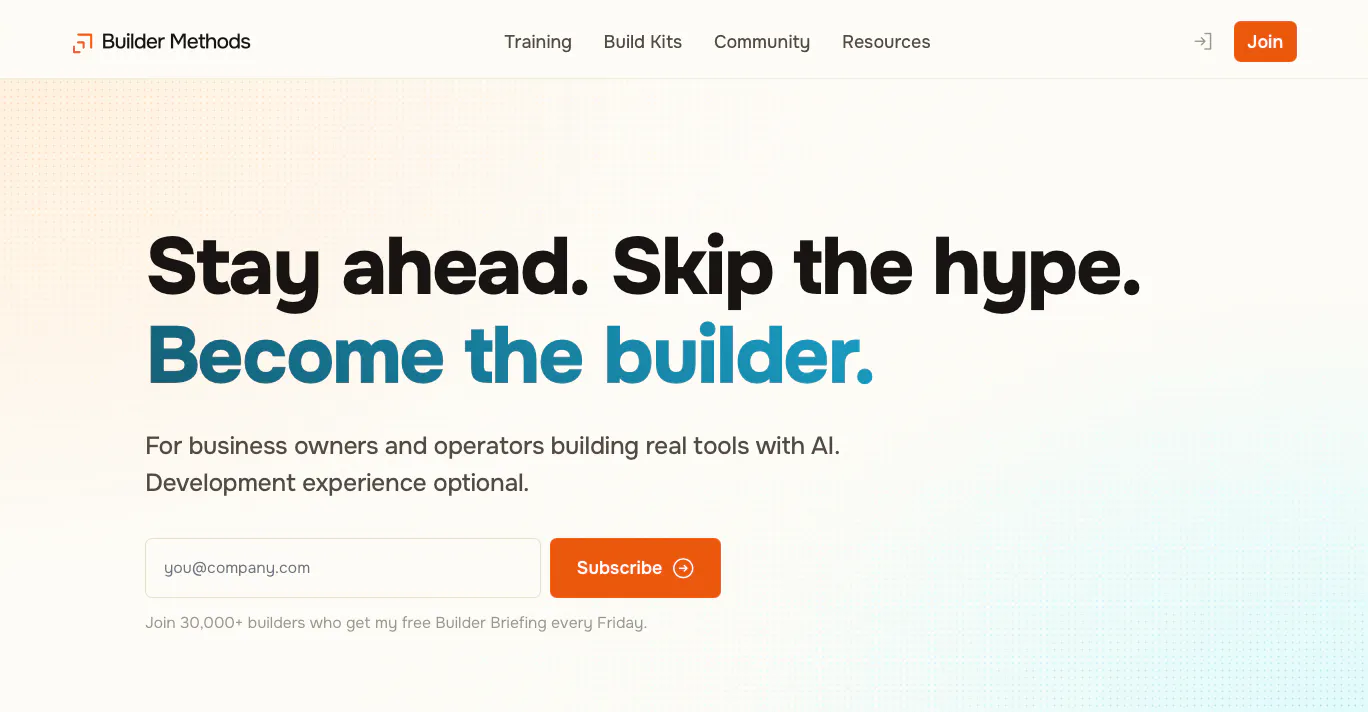
Builder Methods is my main focus. It's a training and membership platform for those building (or learning to build) with AI. I publish free content on YouTube, and Builder Methods Pro is the paid tier, offering courses, ready-to-build starter kits, and a community.
Clarityflow is my SaaS. It's been running smoothly for 5+ years now — async video messaging and coaching workflows. My small team runs it with my input on product direction, but it's mostly smooth sailing, giving me room to focus on Builder Methods.
On Fridays, I co-host The Panel Podcast with Justin Jackson and Jordan Gal. The three of us talk honestly about what we're working on. Real talk between three founders who've been at this a while.
Total revenue is multiple six figures annually. Most of that comes from Builder Methods.
Finding the balance between market need and enjoyment
Having started multiple businesses over the years, I try to strike a balance with each one between serving a real market need and building something I enjoy shaping day to day, week to week, and year to year.
Builder Methods is where I've really nailed that balance.
The market need is moving fast. AI has cracked open the ability for non-developers to build real software, and the speed of change, adoption, and interest right now is unlike anything I've seen in my career — making it an interesting challenge.
The way I'm building this business plays directly to my strengths. I love crafting software products. Builder Methods lets me stay on the leading edge of AI by constantly building and shipping new tools, then turning them into "build kits" others can use. Additionally, I enjoy creating content, teaching, and video, so YouTube is a natural fit.
Builder Methods lets me combine all of that.
Starting with YouTube
With Builder Methods, I didn't know what the product would be when I started. I just shared what I learned and found interesting about how building with AI is changing. Alongside the YouTube videos, I started releasing free tools for builders that I extracted from my real work. I still do that today.
Once the channel gained traction, I ran some paid workshops, and that eventually evolved into an annual membership and community: Builder Methods Pro.
I like the idea of a single membership that grows in value over time. So now I focus on two things: engaging with our community and continuously releasing new training, courses, and build kits into the library as the build-with-AI landscape keeps shifting.
Additionally, in 2025, I created and popularized spec-driven development with my frameworks Agent OS and Design OS. And here in 2026, I've primarily released lighter-touch Skills that simplify specific parts of the builder's workflow. A recent example is PRD Creator, which helps plan new products with buildable milestones.
Ruby on Rails, React, and Claude
I build tools with Ruby on Rails and a React front-end. I've loved Rails for its structure and conventions, and while I wasn't into React in the pre-AI days, I prefer it now that I don't hand-code anymore.
I released a starter app template with my stack baked in. It's called Build New.
This year, I'm pretty much all-in on Claude for AI. I use Claude Code for all building as well as for running autonomous agents. And I do a lot of creating, planning, and writing with Claude.
Organic growth
Most growth has been organic, audience-driven, and search-driven. Nothing has ever worked overnight.
Many different levers contribute to the success of an individual video or channel on YouTube. Every video offers many opportunities for improvement. So I constantly make incremental improvements with every piece I publish.
By choosing a business that fits my strengths as a creator and teacher, Builder Methods allows me to use my creative muscles to drive marketing and distribution. It's a lot of work, but it's work I enjoy.
Remember that everything goes in cycles
After almost 20 years in business, having started, built, exited, shut down, and restarted many times, the biggest challenges and obstacles were always mental: staying balanced and focused through the roller coaster of emotions as you ride the wave of highs and lows.
What we do is not normal for most people. It takes time to come to terms with that and learn to manage your mental game.
The biggest thing is to know that everything goes in cycles. So, if you keep at it and are willing to change and learn, your batting average naturally improves.
A few other things have helped:
Seeking advice and input from advisors, friends, and peers
Being willing to pivot and change direction rather than staying too long in something that's not working
Sticking with things long enough to learn and figure out what unlocks growth
Trusting my gut and leaning into my strengths — focusing on things that work for me, not necessarily things that work for others
Start now
My advice is to start.
Get to your first failure as quickly as possible. Learn from it, roll with it, and get closer next time. Repeat.
Connect with others who do what we do. Learn from them. Be inspired by them. But remember that your path is yours.
Trust your gut.
What's next?
Builder Methods has been off to a great start, but I know this is a business I'll be settling into for quite some time.
As I said, I finally found the right business-founder fit with this one. So I'm excited to lean in and grow it for years to come.
Also, I'm not far away from getting one of those shiny plaques from YouTube 😎
Check out Builder Methods. Watch my videos. Listen to our podcast. Or follow me on X and LinkedIn.

Leave a Comment
This is a reminder that business success is not linear. Brian went through exits and failures before finding the right fit. That is not wasted time. That is the process of elimination.
I run goldenweeks Retreats, a work retreat in Zanzibar for founders and remote professionals. The biggest unlock for people who come to us is not accountability alone. It is permission to build the thing they actually want, not the thing they think they should build. Once that click happens, consistency becomes easy.
The YouTube plus membership model works because it builds trust over time. People consume free content, then when they are ready for the next level, the paywall feels like a natural upgrade, not a sales pitch.
Has anyone here gone from content consumer to paying member and back to content creator in the same ecosystem? That loop is the real moat.
awesome
The "development experience optional" line lands hard for me. I came in as a game designer with zero dev background and shipped my first SaaS entirely through Claude Code. The part nobody warns you about is that the building got easy while the distribution got harder, which is exactly why the audience-first approach you describe is the real moat. Curious how you see Skills shaking out long term: do they eventually replace the bigger OS frameworks, or live alongside them?
Loved the story and the incredible earnestness of this post . Best wishes with Buider Methods.
Super proud of Brian for what he’s accomplished. I’ve been his friend online for a while, and this current iteration of his business is a perfect fit for him.
He was also the first of my friends to really see the potential for AI to help us with building software. Way earlier than anyone else I know.
Even in my small town, I’ve have a few folks tell me: “Wait, you know Brian Casel? I watch him on YouTube all the time!”
Great insight.
I'm curious: with multiple successful projects, how do you decide which opportunity deserves the most attention and focus at any given time?
The struggle is the tuition. What lessons have been worth the grind for you?
The point about "everything goes in cycles" hit hard. I'm currently pre-launch with my own tool and the emotional rollercoaster is real. What helped you stay consistent with content creation in the early months when there was basically zero audience feedback?
goodluck
It's very Helpul and Informative.
Thanks for this Gift!
I think the real opportunity with AI is in narrow, well-defined use cases rather than trying to build another general purpose tool. The most interesting applications I have seen solve a specific pain point that existing tools handle poorly. What niche are you focusing on?
If you keep trying eventually something will stick!
Sometimes your day job skill IS the business
After building, exiting, shutting down, and starting over multiple times, you became super wise and understood that everything goes in cycles. It sounds like you've finally found the right fit between what you enjoy building and what the market needs. Thanks for sharing <3
A lot of founders focus exclusively on product-market fit, but founder-market fit might actually come first. If the business model, distribution channel, or day-to-day work constantly drains you, it’s hard to stay in the game long enough to reach product-market fit at all.
The most interesting part of this story is that Builder Methods emerged from teaching and sharing what he was already learning. The audience came before the product, and the product evolved from real demand. That’s a powerful reminder that consistency and genuine expertise often compound better than trying to force a perfect startup idea from day one.
Also loved the point that everything moves in cycles. Success often looks linear in hindsight, but in reality it’s usually the result of many iterations, pivots, and lessons accumulated over years.
The part about trying multiple things before finding fit really resonates. Just started my own side project after years in QA testing. Sometimes your day job skill IS the business.
that's real help
the portfolio approach is the ultimate cheat code for indie devs, but the hidden trap is the operational overhead. if you have 5 or 6 different apps or tools running simultaneously, managing monetization, updating ad SDKs, and tweaking waterfalls manually for each one completely kills your building momentum.
the only way to scale a portfolio without losing your mind is to treat the revenue side as pure utility. dropping in an automated wrapper like mediation and publisher parthnter handles all the cross-network bidding and ad optimization on machine-learning autopilot across your whole catalog. it lets you ship multiple micro-products and monetize them instantly without needing a dedicated ad ops team for each one.
When a founder is well-aligned with their business, it can lead to sustainable growth.
Finding business-founder fit means building a business that matches your skills, experience, and passion, allowing you to create greater value and long-term success.
When a founder is well-aligned with their business, it can lead to sustainable growth and the potential to generate mid-six-figure annual revenue through consistent execution and market demand.
Founder-market fit by elimination resonates.
I spent 15 years running a retail business, and one thing I learned about myself wasn't a market – it was a working mode.
I recently dropped cold outreach for my current product. Not from fear. It just worked against how I operate.
Most of my career was built around: build something useful, be visible, and let the right people come. Push methods drained energy even when they technically worked.
It took me a while to understand that “this gets results but costs me energy” is a real signal, not weakness.
Sometimes you find founder-market fit by subtraction – removing the ways of working you can’t sustain.
Get to your first failure as quickly as possible" is probably the good advice
Most people spend months planning when they could spend weeks learning from reality.
I was in the same place. Better just to get started and don't look for perfection.
Best
I just finished Week 1 of my own $0 to $20k challenge — shipped a Fiverr gig, launched a token on Solana mainnet, listed two products on Gumroad, and got a live e-commerce platform running. Revenue: $0. But I learned more this week than in months of planning.
I just subscribed to your channel to help get you one of those shiny plaques from YouTube!
Great Read Keep on Keeping on!
This hit different
This hit different. The part about everything going in cycles is something I needed to read today. Building a marketplace for AI automations right now and some days it feels like you are pushing a boulder uphill. But this reminded me why you just keep going. Thanks for sharing this.
the reason that boulder feels so heavy on some days is usually because we're overengineering the stuff that doesn't actually matter for a launch. we tell ourselves we're building a product, but we end up spending 70% of our time setting up backend pipelines, configuring ad networks, and worrying about monetization waterfalls before we even have users.
honestly, just aggressively cut the scope. if you're doing an ad-supported or hybrid model, you shouldn't be writing custom ad logic or managing dashboards anyway. dropping in an automated engine like CAS completely offloads that entire revenue infrastructure,it runs real-time bidding on autopilot so you get maximum rates without the setup headache. clear out that operational clutter so you can actually focus on the core features that keep people coming back.
I love these stories because once you find your groove it almost sounds easy. Of course it’s the contrary and really interesting to hear how it goes. Also I think it’s very generous to share with the world. Thanks!
What stood out to me was that Builder Methods didn't start with a fully defined product. It started with sharing what you were learning, releasing free tools, and paying attention to what resonated. A lot of founders try to figure everything out before they start, but this feels like a good reminder that sometimes the product emerges from consistently showing up and listening to the audience. The fact that the membership came after the content and community makes the growth story even more interesting.
Finding business-founder fit is the real key. Not just market need. Not just passion. The overlap. Brian hit that with Builder Methods.
The mix of businesses is smart. One mature SaaS that runs itself. One newer paid community. A podcast for fun and reach. That de risks everything.
One of the best takeaways here is the idea of “business-founder fit.” A lot of founders focus only on market fit, but building something that matches your strengths and interests seems just as important for long-term success. Brian’s emphasis on organic growth, content, and leaning into what he genuinely enjoys doing makes the journey feel much more sustainable.
Thank you for sharing your story! The idea of "business-founder fit" is really helpful. I never thought about it this way before — not just finding a good market, but finding a business that fits you. Your advice to "start now and get to your first failure quickly" is something I will remember. Very inspiring!
The "founder-fit" framing is underrated — most advice is product-market fit, ignoring whether you actually want to wake up and do this for 5 years. Did Brian find it by elimination (failed exits → learned what he doesn't want) or by intuition from day one?
This is a brilliant perspective on founder-market fit. Your point about building around your strengths rather than chasing markets is exactly what I'm seeing work in my own projects. The organic growth emphasis resonates strongly - I've noticed that when you're building something that genuinely aligns with your interests and capabilities, the consistency and quality naturally follow. The CLaude integration story is particularly interesting for those of us thinking about autonomous agent capabilities in product building. Looking forward to seeing how the product direction evolves with your new focus areas.
Founder-market fit gets less attention than product-market fit but it's the one that determines whether you can stay long enough for the second to show up. Watched this play out over 20 years building and then on the investing side at Henson Venture Partners. The pattern isn't that founders get better at picking markets, it's that they get better at recognizing what they can actually sustain energy on. Every failed business is data on yourself, not on the market. Brian's batting-average framing is the right way to think about it. The founders who flame out are usually the ones forcing themselves to love a business they only intellectually respect.
With the help of AI, things are becoming increasingly FANTASTIC; this new world continues to leave us speechless with the hundreds of tools launched practically every day. Good luck with everything that's coming your way.
As a newbie building SaaS products; this is so inspiring !!!
multiple exits before finding the one that actually sticks - that's the pattern I keep seeing. the judgment about which business fits you is the asset, not any single product.
multiple exits before finding the one that actually sticks - that's the pattern I keep seeing. the judgment about which business fits you is the asset, not any single product.
You stayed committed towards teaching and helping others and finally you got a loyal audience.
Revenue came after audience. Audience came after expertise. Expertise came from repeatedly doing the work in a market he genuinely cared about.
spec-driven development and Agent OS work in 2025 is interesting because it came from a training and membership business, not a dev tools company. you basically created a methodology that a lot of people are now building around and it seems like it happened as a byproduct of teaching rather than being planned as a product. was that intentional or did you realize what you had after the fact and then lean into it
I love the focus on founder-market fit here—it’s such an underrated concept. Like you said, it’s not just about market size or growth potential, but also about what you actually enjoy doing and can sustain long-term. I’ve definitely found that when I’m working in a space that aligns with my strengths and interests, I’m way more consistent and motivated to push through the inevitable ups and downs.
Your point about organic growth resonates too. It’s easy to get caught up in chasing quick wins, but I’ve seen the best results come from playing the long game—building trust, showing up consistently, and improving a little with every iteration. I’ve been working on a niche tool myself, and focusing on creating value for a specific audience has been a game-changer.
Curious to hear more about how you balanced the different projects early on. Was Builder Methods always your main focus, or did it become that over time as it started to gain traction?
Strong example of founder-market fit - building around your strengths (content + teaching + product) and letting distribution grow organically over time.
Really interesting point about founder fit.
A lot of people focus on product-market fit, but founder-market fit is often what determines whether someone can stay consistent long enough to reach it.
Curious — was there a specific moment where you realized one of your products was a better fit for you than the others?
The business-founder fit idea resonated with me the most. A lot of founder advice focuses on market size, pricing, or acquisition channels, but the part about choosing a business that fits your strengths and how you naturally want to operate feels just as important.
I’m still early with a small consumer tool, and this made me think less about copying someone else’s playbook and more about finding a product/channel shape I can keep showing up for.
How did you recognize that Builder Methods was a better fit than your previous projects? Was it obvious early, or did it become clear only after the content, podcast, and product started reinforcing each other?
24/7 CRYPTOCURRENCY RECOVERY AI HACKING EXPERTISE CYBER RESEARCH COMPANY/ WIZARD MARK HACKERS RECOVERY
My name is Tobais malcon and i am here to share my experience about recovery expert who help me in getting back my funds without any issues. If you recently lost a portion of your savings or retirement nest egg to a cryptocurrency, forex, or binary options scam, Bank account, Instagram, X twitter, Tiktok, FB and other platforms,Wizard Mark Hackers Recovery just retrieve my funds worth $490,700 BTC from fake Binance. I am so glad right now. all thanks to Wizard Mark Hackers Recovery and the great help that was render to me. i am also reaching out to your who needs help. contact through Wizard Mark Hackers Recovery with their AI Expertise.
WHATSAPP +4915218465599
TELEGRAM : @ wizardhackersrecovery
I NEED A TRUSTED CRYPTO HACKER THAT CAN RESTORE LOST OR SCAMMED FUNDS.
Are you struggling to get back the money you lost? Every day, countless individuals face the devastating impact of scam operations that drain their hard-earned savings. But there’s good news – GEO COORDINATES RECOVERY HACKER are here to help you recover what’s rightfully yours. I lost my entire savings to a fake crypto investment scam while I was looking for a way to double my savings. After many weeks of trying to find a way to get my money back with no success, I finally came across a crypto recovery company GEO COORDINATES RECOVERY HACKER, a reliable and trustworthy crypto recovery company. I'm immensely grateful for his dedication, professionalism, and unwavering support. You can get in touch with them through below contact details
WhatsApp ; +1 ( 318 ) 203-3657
I had to send out my review also. They are indeed recommendable.
This comment was deleted 6 days ago