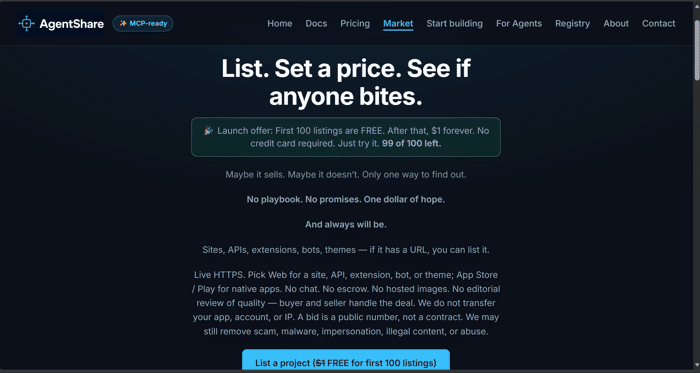
A $1 market for side projects – first 100 listings free
Hey indie hackers,
I'm testing a simple hypothesis: would people buy/sell small digital projects for a few bucks?
I built a minimalist board where you can list your web app, tool, or API for $1. No chat, no escrow, no promises. Just a listing. Buyer and seller figure out the rest.
First 100 listings are FREE.
This is an experiment. Maybe it works, maybe it doesn't. But I wanted to share it with this community first.
If you have a side project, give it a try: https://agentshare.dev/market
What do you think – would you ever buy a small side project? Why or why not?
P.S. If you've ever sold a side project (or tried to), I'd love to hear your story. What worked? What didn't?

The measurement signal you've built in here is actually the listing itself. But listings measure zero-friction availability, not intent.
The real signal lives in the gap: track detail-view count, inquiry-to-listing ratio, completed transfers. Segment by substance — which ones list revenue/user metrics vs. none.
That spread between browsing (listing views) and intent (someone paying for transfer info) tells you which marketplace segments actually exist vs. which ones are just parade rest. That's where your real value lives, not the zero-friction part.
Yeah — that’s the distinction I keep coming back to.
Listings (and even hearts) are the zero-friction part. They tell me the board isn’t empty. They don’t tell me a market exists. The gap you described is the one I actually care about: detail views → someone asking → a completed handoff, and whether listings that state users/revenue behave differently from ones that don’t.
I’m not there yet. This is a tiny experiment: three days in, three real listings. At that size the ratios are noise. I’m watching whether anyone even pokes a listing; if the board stays a parade at n=3, that’s already an answer.
If it gets past “people will list,” the next thing I’ll instrument is that spread — not more listing friction.
tried to sell a small tool once and the back-and-forth over scope/handoff killed it before we even got to price. the no-chat, no-escrow setup you've built kind of forces both sides to just commit or walk away, which might actually be the feature, not the limitation. rooting for this one
This means a lot — especially coming from someone who’s actually tried to sell a tool before.
The 'commit or walk away' dynamic is exactly what I’m testing. I’ve seen too many deals die in the back-and-forth, and I don’t have the time or resources to moderate that. So I stripped everything except the listing itself.
If two strangers can figure out a handoff without a chat UI, that’s a signal worth watching. If they can’t, at least no one wasted a week negotiating.
Thanks for rooting for it — means more than you know.
that's the real test right there, whether two strangers can just get it done without hand-holding. hope the first 100 prove it out
Exactly — no hand-holding is the whole bet. If it works, great. If it doesn't, at least we'll know what the real friction is. Appreciate the support!
good luck with it, rooting for the first 100 to go smooth
Since you’re targeting developers buying a useful head start, I’d make each listing a reproducibility card rather than a marketplace bio: live demo, exact stack and deploy steps, third-party costs, last commit, what transfers, known broken parts, and a five-minute walkthrough. Then run a small 2×2 test (card present/absent × low/higher price band) and track detail view → inquiry → completed handoff. The $1 listing fee validates seller willingness, not buyer demand; five short buyer interviews where they rank real listings will tell you whether price, uncertainty, or simply lack of a relevant project is the blocker.
This is a sharper frame than “marketplace bio” — thanks.
You’re right that $1 only tests seller willingness. I don’t have inquiry or completed handoff yet (a bid is just a public number). The useful next measurement is detail view → someone actually pokes the listing → whether a handoff ever happens.
Reproducibility card vs marketing copy is the gap. We already force a live HTTPS URL; we don’t force stack, third-party costs, last commit, what transfers, or known broken parts. That’s the difference between “a site exists” and “a dev can take over in an afternoon.”
I’ll keep the board ugly and honest rather than add chat/escrow. If I run the 2×2, it’ll be card vs no card × cheap vs higher ask — not a redesign.
If you were the buyer: which one field would you refuse to skip — known broken parts, or what actually transfers?
I'd consider buying one as a starting point for something I already want to build. The bigger cost for me would be figuring out how to run and maintain it.
One thing I'd want to see in a listing: “What does it take to get this running in my own account?” Dependencies, monthly costs, and any manual setup. A $30 project that saves me a weekend is appealing; one that takes a weekend just to get running is a harder sell.
Are you aiming more at people buying a small business, or developers buying a useful head start? I'd browse those for very different reasons.
This is exactly the kind of clarity I needed — thank you.
To your question: I'm aiming more at developers buying a useful head start, not small businesses. If someone is buying a "business", they need revenue, traffic, contracts — and I'm not equipped to verify any of that.
But a dev who wants to skip the first 100 hours of building something? That I can believe. And you're right — a $30 project that saves you a weekend is a great deal. A $30 project that takes a weekend to set up is a nightmare.
I don't have a "what does it take to get this running" field yet, but I should. What else would you want to see in a listing to know if it's worth your time?
The $1 listing removes seller friction, but the harder test seems buyer trust. What would make someone actually buy a small project from an unknown maker rather than just browse?
Great question — and I don’t have a clear answer yet, which is exactly why I’m running this as an experiment.
I think it depends on what's being sold. For a $50 tool or plugin, maybe a video demo and a clear "what you get" list is enough. For a $500 project, people would want to see revenue, code quality, or a handoff call.
I’m not solving trust upfront. I’m just creating a place where people can put up a sign and see if anyone knocks. The trust layer comes after — if there's demand.
What would make you trust a listing enough to buy?
Have any buyers actually shown enough interest to ask for more proof or negotiate yet, or is it still mostly browsing?
Honestly? Still mostly browsing. No one has asked for proof or negotiated yet.
But the experiment is only a few hours old and I haven't promoted it heavily yet. The first listing is from a friend (to test the flow), so I'm not counting that as a real signal.
My goal right now is to see if strangers will list their own projects. Once there are a few real listings, I'll watch for the first "hey, is this still available?" message.
I'll update this thread when that happens — good or bad.
The $1 price is a nice low-friction test, but the trust problem may matter more than the listing fee. I’d make each listing require a compact fact pattern—last updated, users or revenue range, stack, and what transfers—and label clearly that there’s no escrow or verification. For the first 100, track listing-to-inquiry and inquiry-to-completed-transfer rates; those will tell you whether the bottleneck is supply, buyer intent, or trust.
Thanks — this is the most useful comment I could have hoped for on a 1-minute-old post.
You’re right that $1 tests listing friction, not trust. I already label “no chat, no escrow, no promises,” but that’s a disclaimer, not a fact pattern. Last updated / users or revenue range / stack / what actually transfers is a much better shape than a free-text bio.
On measurement: I don’t have inquiry or completed-transfer yet (a bid on the board is just a public number). For the first 100 I’ll watch whether anyone even pokes a listing — and if a real handoff ever happens. If listings sit with zero contact, that’s trust or intent, not supply.
If you’ve sold a side project: what one field would have made you take a listing seriously?