Launching countless apps until one gained momentum and hit $3.3.k MRR

Jakub Mužík has built countless apps while working a 9-to-5 job that bores him. Most made $0. But then one took off. Now, Leadverse is at $3.3k MRR.
Here's Jakub on how he's doing it. 👇
Getting tired of corporate work
I have worked as a Salesforce developer in a 9-5 job for eight years. After a few years in a corporate environment, you learn most things. The work grows repetitive, and you simply trade time for money — nothing I enjoy.
Four years ago, for my bachelor's thesis, I built a mobile app: a simple social media app that mapped your current location and showed local events around you. It was the first time I built an app that people downloaded and gave positive feedback about. The feeling was amazing. Since then, I've been non-stop building and working on side projects in my free time.
I've built countless apps. Most made $0. Then, I finally built something that clicked almost immediately: a social media lead generation tool.
Ten months ago, I saw a post on Reddit. Someone was asking other builders what they were building and offering to send them Reddit posts from people seeking their solutions. The post went viral. Hundreds of people commented, needing help with lead generation. And it gave me an idea.
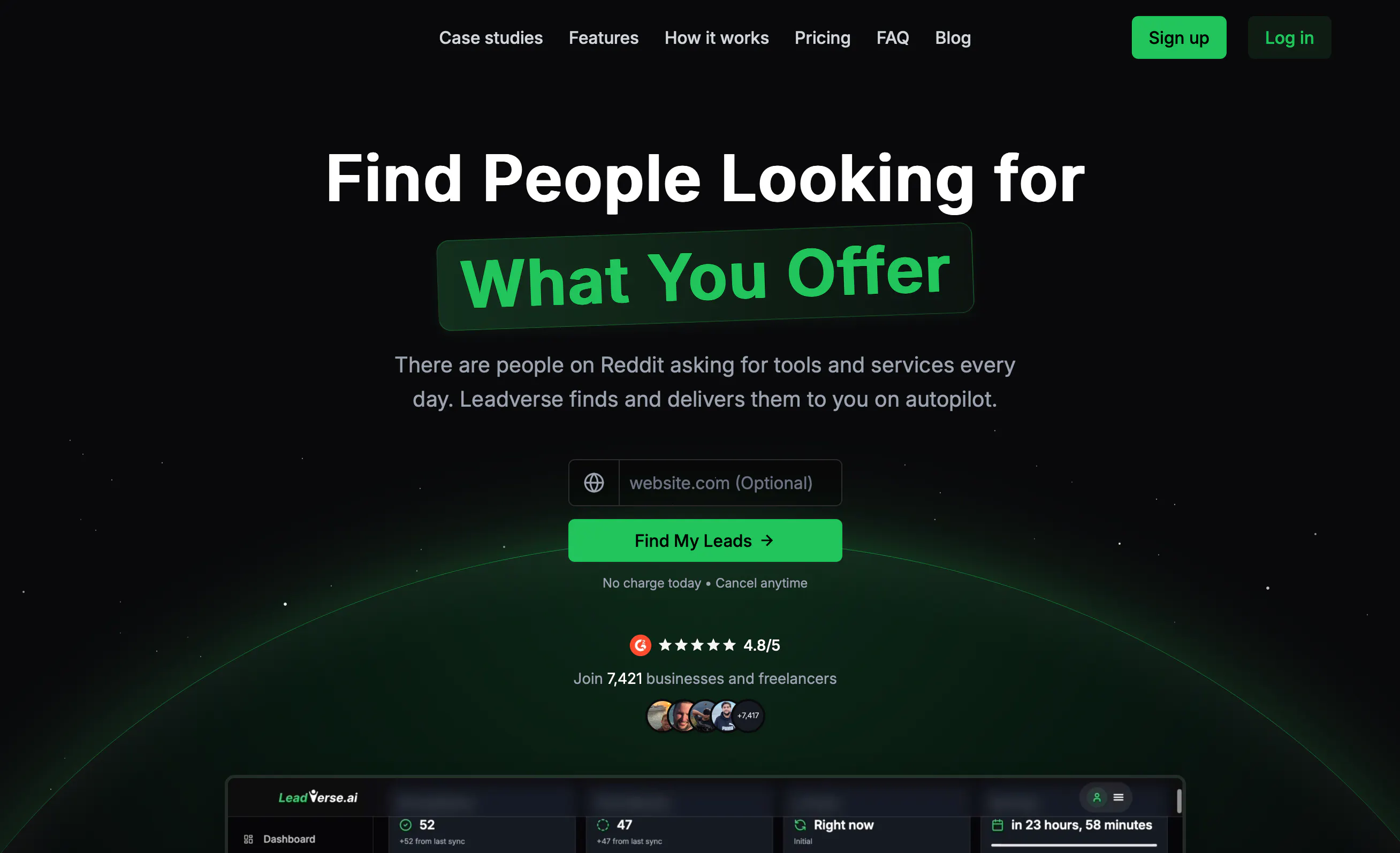
So, I started building my own lead generation tool, Leadverse. The idea is simple: You paste in your product or service, and the tool continuously looks for new social media posts asking for what you provide. This removes the 'spam' approach of cold email tools, because you only reach out to people already asking for your help. And since the DMs are automated too, you can get traffic on autopilot.
Fast forward to today, I've crossed $20k in gross revenue, with 130+ paying customers and $3.3k MRR.
Finding time to build
I'm building it solo, fully bootstrapped. I build it on nights and weekends.
My dev background made building it straightforward. The MVP took about a month, but that's just because I'm very busy with my 9-to-5 job, freelance gigs, and family — I recently had a baby. So, finding free time to focus on my side projects is my biggest challenge.
After building it, I posted on Reddit in the same format I saw working before — asking other builders to share what they were building and offering to send them leads for free.
The post went viral, as I expected, bringing in traffic and my first paying customers.
Technical difficulties
Here's my stack:
React (frontend)
Supabase (backend)
Stripe (payment gateway)
Resend (email automation)
The biggest technical challenge so far has been balancing LLM costs and output quality. The entire lead generation engine I built is fully AI-powered, and the LLM API calls account for 90% of my costs. So, I'm continuously optimizing LLM prompts and changing models to cut costs while maintaining high output quality.
Finding the right business model
I started with a freemium model. Everyone could sign up and use the tool until they reached a certain number of leads. It seemed like the safest option, but it wasn't.
My main traffic source is Reddit, which means:
Many users have no intention to use the tool long-term.
People sign up just to test the free tier once.
Reddit is amazing to grow your traffic; however, you must account for slightly lower user quality. Normally, I wouldn't care, but it increases my cost per user, so my model didn't make sense.
I switched to a three-day free trial with CC details required upfront and saw improvement almost immediately. Fewer people started the trial, but the conversion rate was much higher.
This meant less money wasted on non-serious users and more money from users who intended to use the tool.
Then, I increased the free trial from three days to seven days. This further increased the numbers. Three days was too short. People didn't have enough time to see the value.
I still use a 7-day free trial today and do not plan to change it anytime soon.
Finding the right pricing model
As far as pricing, I initially thought cheaper was better. I was wrong.
I've experimented extensively with pricing, lowering prices for a few weeks, increasing them, and always watching the data. Lowering prices never improved conversion. Quite the opposite. If you price it too cheaply, there's a certain threshold where trust decreases, and it feels low quality. People bounce before even trying it.
I also saw fake users more often. By fake users, I mean those using "special" credit cards that fail to convert after a week due to "insufficient funds." I never knew people did that until launching my own SaaS.
Overall, I started with a €9/mo plan and a €14/mo plan. After about a month, I switched pricing from EUR to USD. Conversion increased. No other changes occurred at that time.
A few months later, I added a third $19 plan and a custom plan option. The Custom plan allowed users to change limits and adjust pricing based on their needs.
This marked another significant turning point. So far, around 30 users have opted for the custom plan. I can't believe I didn't do this sooner.
Dogfooding and posting on Reddit
All of my revenue has come organically from Reddit. Two tactics:
My tool promotes itself. I use it to automatically find and contact people asking for help with lead generation.
I post two times per week on Reddit. Certain post formats almost always work: sharing a story, your product growth, your revenue numbers, and adding valuable insights you've learned. Then casually mention your tool name. That's it. This format almost always works, and once you go viral, traffic is almost guaranteed.
Apart from that, I've built some free tools and optimized my page for search engines. However, I haven't noticed much conversion from this organic traffic yet. Something I need to work on. I started with this months after launch, and I wish I'd started from day 0
I've also started offering affiliate partnerships. I have around 20+ partners now, but I still don't see any conversions coming from that. It's nothing I'd recommend.
Landing page tweaks
Landing page tweaks have also been helpful. I started with a very simple landing page. Over time, I made these changes (in this order):
Added a walkthrough video right under the hero section
Made the entire page more personal (added my photo, replaced all "we/us" with "I/me")
Collected real testimonials and placed them before pricing and on the checkout page
Replaced my custom checkout with Stripe-hosted checkout (people worried about entering credit card details on my site)
Added “Book a free demo” option
All of these changes drove conversion.
Get inspired and share your learnings
Building in public on X has also been a huge advantage. I regularly post my progress, insights, and failures on my X profile in the Build in Public community. This helped me meet other amazing founders and get inspired by them.
That's probably the best advice I can offer: Get inspired.
You don't need to reinvent the wheel. See what already works — whether it's a product idea, marketing strategy, or post patterns. Surround yourself with people with common interests, get inspired, share your own learnings, and keep going.
What's next?
From here, I want to get enough recurring revenue to quit my 9-to-5 job and go fully into indie building.
You can follow along on X, where I share my story and progress. And check out my SaaS: Leadverse.ai.

Leave a Comment
What's most fascinating to me is that it was momentum gained from sending out a lot of ideas — not momentum gained from getting the first idea right.
It's a good difference between creating a lot of things and jumping from idea to idea. When each firing provides you with a better idea of the market, pricing, acquisition or positioning, the unsuccessful products do a valuable job.
I also liked the emphasis on business model and pricing based on actual use, as well as business model, when I saw the real usage.
One could get so caught up in the decision making process that one spends too much time getting it right before anyone has even used the product.
After that many experiments, it is worth noting that a volume of $3.3k MRR is a pretty good example of how shipping volume can lead to better judgments.
Really appreciate how transparent this is, especially the pricing section. The point about cheap pricing lowering trust rather than boosting conversion is something a lot of early founders learn the hard way I've seen the same pattern with SaaS products where dropping the price actually increased churn instead of reducing it.
The shift from freemium to a 7-day paid trial with CC upfront is the real unlock here though. It's a good reminder that "more signups" isn't the goal "the right signups" is. Curious how you're thinking about scaling the Reddit channel without it becoming saturated as more people copy the same post format. Are you diversifying distribution yet, or doubling down on Reddit since it's still converting well?
Congrats on crossing $20k gross solid proof that shipping many small bets eventually compounds into one that works.
Love this. The grind is real. Countless apps making $0 before something finally clicks. That's the part people don't see. They just see the $3.3k MRR and think it happened overnight. Building on nights and weekends with a newborn? That's insane dedication.
The useful lesson here is that the winning product was not the first idea—it was the one with a clear trigger and a reachable audience. I like that you treated the seven-day trial and pricing changes as experiments rather than beliefs. For a side project with limited hours, I’d track one activation event before optimizing conversion: the moment a user sees a lead that is specific enough to contact. That should tell you whether the product is creating value before trial length or price muddies the signal. The Reddit distribution loop is also unusually strong because the channel contains the pain, not just attention. As you move toward leaving the 9–5, which metric gives you more confidence: recurring revenue, the number of customers who would notice if Leadverse disappeared, or the repeatability of acquiring the next ten customers?