Hitting $25k+ MRR by making his goals less
ambitious

Dmytro Krasun failed over and over until he started focusing on goals that were more achievable. Then, he built ScreenshotOne and grew it to $25K+ MRR in four years.
Here's Dymytro on how he did it. 👇
Smaller goals
I had been a software engineer for 10+ years before I quit my job. I had a degree in computer science and all that. But I've always wanted to be an entrepreneur.
I prefer to have autonomy and independence — especially about the areas I want to work in.
So, I kept trying to start something, but failed each time. My goals were to big. I only started seeing results when I downgraded my ambition and focused on achieving small things in easy steps.
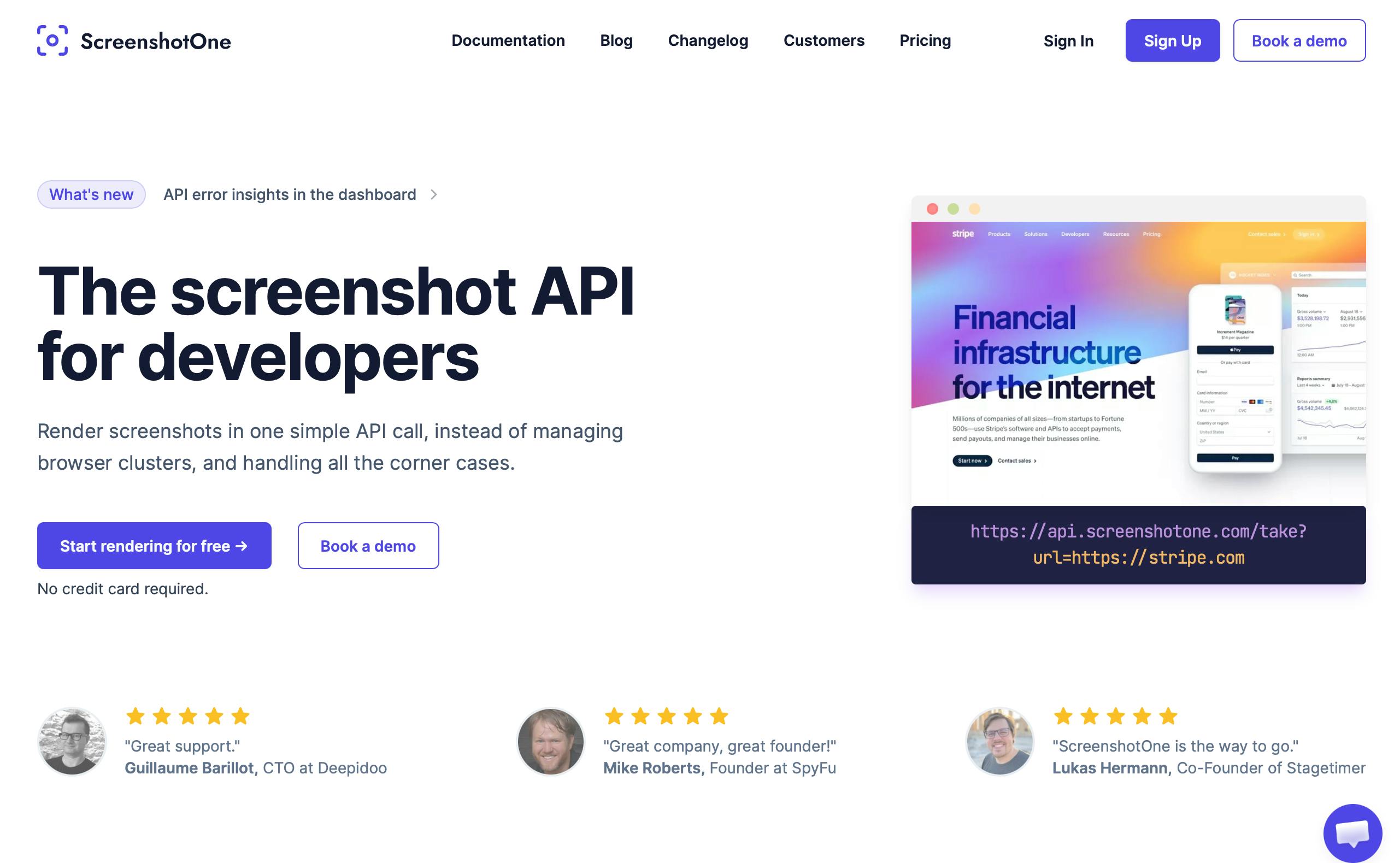
Now, I am working on ScreenshotOne, a screenshot API for developers and AI agents. It is my passion and my only focus. We have over 800 paying customers, and we're making over $25k MRR.
From simple to "exploded" stack
I spent five months building it, from January to May 2022. There weren't any AI coding agents back then. Plus, I took breaks because it was really, really hard.
The stack started as one simple server, Go for everything, and JavaScript for managing browsers in the beginning.
But later, my stack exploded. Now it is:
Next.js for our dashboard
Astro for my marketing website
Go for managing rate limits and API keys
TypeScript for managing browsers
Cloudflare for cache, API gateway, and storage
Kubernetes for hosting browsers
And plenty more...
Know your market
In the beginning, I grew by posting about my product everywhere. I also did paid ads.
The channel that really started working for me was Reddit. But I don't think that would work for everybody.
You need to experiment a lot and double down on what works.
Outside of finding the right channels, the thing that changed my growth trajectory most was realizing who I was selling to.
I know it might sound dumb, but it took me two years to realize that. And it changed everything. How I market things, what I write, what I build, pricing — everything.
If I started over, I would build for myself. Or I would really, really invest in knowing who I build my application for.
Tweaking revenue
I use a subscription model, and I charge for extra requests — think "pay as you go."
I recommend setting up product analytics like PostHog, and tracking how many people convert from visitors to users to paying customers — and from what sources.
Then, try to change things to grow these numbers. Don't have visitors? Work on attracting them. Have visitors, but they don't sign up? Improve your signup flow.
It sounds simple, but it is not.
Tuning the funnel consistently is what helped me grow my revenue.
Ignore my advice
Don't listen to any advice.
Most people — myself included — don't know how to extract lessons and advice from their experiences. And even if they extract it, it is usually outdated.
Read the classics on economics, business, history, and biology. Fundamentals.
What's next?
From here, I want to automate my current product so that I can go on a hiking trip for a week without access to the internet.
I also want to grow to $50k MRR.
You can follow along on my personal website and newsletter. I am active on X too. And check out ScreenshotOne!

Leave a Comment
Curious, what made you realise you needed to simplify your approach?
"I only started seeing results when I downgraded my ambition" — this is the line I needed to read today.
I spent months overthinking what to build. Today I stopped overthinking and just shipped. Built and launched two AI SaaS tools in one day with zero coding background.
Not perfect. Not big. But alive on the internet.
Also taking note of the 'know your market' lesson — I already know mine (side hustlers who don't know what business to start) and I'm going to keep that focus sharp.
Dmytro, $25k MRR in four years starting from scratch is exactly the kind of timeline that feels achievable. Thanks for keeping it real.
The smaller goals framing is counterintuitive but I've seen it play out exactly this way. The big ambitious target creates a paralysis loop. You can't make progress on "build a $1M business" in a single afternoon. You CAN make progress on "talk to 3 potential customers this week." I spent my first year thinking in years, and almost nothing moved. Switched to thinking in weeks and the momentum changed completely. The "ignore my advice" section is the honest part most founders skip. Almost all founder advice is reverse-engineered from success and doesn't account for the 1,000 ways the same moves fail in different contexts. What would you say is the single thing that made ScreenshotOne stick when the other attempts didn't?
Awesome, I learned a lot from this post. Because my product literally uses what you are offering but I am doing that in-house not off-loading to third party... So technically what VisualSentinel does is takes screenshots and compare with the baseline to find out if the UI of the website changed or DNS updated or site is down.. Consider it Uptime but better.
Also insight regarding reddit was quite helpful I may utilize that in the marketing part of my product..
The "smaller goals" approach is exactly what we're applying at InnerSpark. We're building a modular OS for founders (big vision) but launching tiny bets first - cashflow modules like DomainFlow and CashOS before the full Idea Engine.
Dmytro's point about taking 2 years to truly understand the market hits hard. We're documenting these Indie Hackers stories to extract patterns before building. Distribution first, not product first.
Question: Did Reddit work because you were solving a developer problem that developers congregate around? We're betting on LinkedIn + Indie Hackers for our founder-focused modules. Curious if channel-market fit was obvious early or discovered through trial.
This is pretty underrated. Most founders try to build the billion-dollar thing first.
Gotta keep in mind that small, boring wins can win.
The "smaller goals" reframe is the most honest advice in here, and also the hardest to internalize because it feels like giving up when you do it, and only looks like wisdom in hindsight.
What I'd add to the market insight section: there's a difference between knowing who your customer is and knowing why they're buying right now. Dmytro mentions it took two years to really understand his market I'd guess part of that delay was the gap between "developers need screenshot APIs" (category) and "developers are using this to automate QA workflows and they're blocking on it weekly" (specific job-to-be-done with urgency). That specificity is what changes pricing, messaging, and what you build next.
The "ignore my advice" section deserves more attention than it gets. The useful frame isn't "advice is worthless" it's that most tactical advice is context-dependent and the context is never fully transferable. The classics on economics and incentives hold up because they're describing human behaviour at a level of abstraction that survives context change. The rest has an expiry date.
One question worth reflecting on for anyone reading: Dmytro mentions Reddit worked for him but might not for everyone. The real insight there is channel-audience fit the channel that works is usually the one where your specific buyer already congregates to talk about the problem, not the channel with the most users.
Congrats on 800 paying customers. The hiking trip milestone is the right one to aim for.
This really resonates with me.
I’ve noticed that my biggest breakthroughs usually came after I lowered the ambition and focused on smaller, achievable steps I could ship consistently because momentum beats “perfect plans.”
The way Dmytro narrowed in on a clear market, then kept tuning the funnel (visitors → signup → paid) is the kind of boring, repeatable work that actually compounds.
Also loved the “simple to exploded stack” arc every product I’ve seen starts clean, then complexity grows as customers and edge cases arrive.
We are looking for someone who can lend our holding company 300,000 US dollars.
We are looking for an investor who can lend our holding company 300,000 US dollars.
We are looking for an investor who can invest 300,000 US dollars in our holding company.
With the 300,000 US dollars you will lend to our holding company, we will develop a multi-functional device that can both heat and cool, also has a cooking function, and provides more efficient cooling and heating than an air conditioner.
With your investment of 300,000 US dollars in our holding company, we will produce a multi-functional device that will attract a great deal of interest from people.
With the device we're developing, people will be able to heat or cool their rooms more effectively, and thanks to its built-in stove feature, they'll be able to cook whatever they want right where they're sitting.
People generally prefer multi-functional devices. The device we will produce will have 3 functions, which will encourage people to buy even more.
The device we will produce will be able to easily heat and cool an area of 45 square meters, and its hob will be able to cook at temperatures up to 900 degrees Celsius.
If you invest in this project, you will also greatly profit.
Additionally, the device we will be making will also have a remote control feature. Thanks to remote control, customers who purchase the device will be able to turn it on and off remotely via the mobile application.
Thanks to the wireless feature of our device, people can turn it on and heat or cool their rooms whenever they want, even when they are not at home.
How will we manufacture the device?
We will have the device manufactured by electronics companies in India, thus reducing labor costs to zero and producing the device more cheaply.
Today, India is a technologically advanced country, and since they produce both inexpensive and robust technological products, we will manufacture in India.
So how will we market our product?
We will produce 2000 units of our product. The production cost, warehousing costs, and taxes for 2000 units will amount to 240,000 US dollars.
We will use the remaining 60,000 US dollars for marketing. By marketing, we will reach a larger audience, which means more sales.
We will sell each of the devices we produce for 3100 US dollars. Because our product is long-lasting and more multifunctional than an air conditioner, people will easily buy it.
Since 2000 units is a small initial quantity, they will all be sold easily. From these 2000 units, we will have earned a total of 6,200,000 US dollars.
By selling our product to electronics retailers and advertising on social media platforms in many countries such as Facebook, Instagram, and YouTube, we will increase our audience. An increased audience means more sales.
Our device will take 2 months to produce, and in those 2 months we will have sold 2000 units. On average, we will have earned 6,200,000 US dollars within 5 months.
So what will your earnings be?
You will lend our holding company 300,000 US dollars and you will receive your money back as 950,000 US dollars on November 27, 2026.
You will invest 300,000 US dollars in our holding company, and on November 27, 2026, I will return your money to you as 950,000 US dollars.
You will receive your money back as 950,000 US dollars on November 27, 2026.
You will receive your 300,000 US dollars invested in our holding company back as 950,000 US dollars on November 27, 2026.
We will refund your money on 27/11/2026.
To learn how you can lend USD 300,000 to our holding company and to receive detailed information, please contact me by sending a message to my Telegram username or Signal contact number listed below. I will be happy to provide you with full details.
To learn how you can invest 300,000 US dollars in our holding, and to get detailed information, please send a message to my Telegram username or Signal contact number below. I will provide you with detailed information.
To get detailed information, please send a message to my Telegram username or Signal username below.
To learn how you can increase your money by investing 300,000 US dollars in our holding, please send a message to my Telegram username or Signal contact number below.
Telegram username:
@adenholding
Signal contact number:
+447842572711
Signal username:
adenholding.88
"It took me two years to realize who I was selling to" — this hit hard. I'm going through this right now. Built my product to solve my own problem as a creator, but I'm starting to realise the people who'll actually pay are social media managers and agencies managing multiple clients. Completely changes what I should be building and how I talk about it.
The funnel tuning point is spot on too. I've been focused on getting more signups when the real leak is between signup and first action. 40% of my users take the first step but only 4% complete the core action. That gap is where the real work is — not more traffic.
This really resonates with me because when I first started building my app, I had so many ideas, and it was originally inspired by something completely different.. I wanted to do everything at once, but in the end, I realized that while everyone says to "just" build an MVP, an MVP in 2026 is not the same as an MVP in 2013. Let's be honest. So I really empathize with this, because I also had to cut things down, focus on the design, and keep it simple, not only for myself, but also for the people who could actually use my app today. So we'll see what people think.
This really resonates.
The idea of lowering goals to make progress actually happen is underrated — especially in SaaS where it’s easy to overcomplicate things early on.
I’ve noticed something similar not just in building, but even in how founders monitor their products.
Instead of trying to track everything constantly, focusing only on what actually matters (like key revenue changes or critical events) makes things much more manageable.
Curious — did simplifying your goals also change how you track and monitor your product day-to-day?
This is such a counter-intuitive but necessary perspective. We’re often told to 'aim for the stars,' but that usually leads to a roadmap that's impossible to execute for a solo founder. By lowering the bar, did you find that your focus shifted more toward daily consistency rather than just long-term anxiety? I'm currently launching my first extension and I'm struggling with exactly this—balancing a big vision with the small, boring tasks that actually move the needle.
kinda funny how lowering ambition can actually increase revenue
but it makes sense — smaller scope → faster feedback → more iterations
I’ve seen people spend months polishing something “big” while others ship something basic and just keep improving it
This is such a refreshing take. We’re always told to 'aim for the stars,' but sometimes that just leads to burnout. Did you find that lowering your bar actually made you more consistent in your daily work? I'm trying to find that balance right now with my own project.
Way to Go Dmytro! and congrats. I know its not easy. I'm on the same journey
Yes, I think that focusing on the "one" thing your product does best, and the type of person who would appreciate it is the key to getting traction. I am my own worst enemy; I get a good idea then immediately want to add more features and expand the pool of potential users. The result is that I dilute the value prop and lose focus on who it would benefit. I think it's human nature to get excited by a good idea and immediately want to shoot for the moon. But focus on the core value and get the first excited clients, and the rest will follow naturally.
My number one problem right now is finding channels to let people know about my product. Any guidance greatly appreciated!!
Thanks for having me, James 🙏
That's really inspiring. Finding the channels to let people know about your product is currently my #1 problem: you can build literally anything, but finding the audience is something I'm still struggling with.
Very interesting!! Seeing someone succeeding becomes my fuel in my journey. Love that, let's keep going!
确实很能给人启发,我想通过API代理让每个人都能用的起token,这个想法真的有人会愿意了解吗?
What stood out to me most is that it took time to truly understand the market, and that realization changed pricing, messaging, and product decisions. That part feels very real. A lot of founders obsess over features, but the bigger unlock is often understanding exactly who is buying and why. Great reminder that distribution and customer clarity matter just as much as building.
Great article, its impressive that you were able to generate to $25k MRR through screenshot API tool
Great article. I like the point about focusing on smaller achievable goals instead of chasing huge milestones from the start.
I'm currently experimenting with a small web project inspired by the Million Dollar Homepage — a pixel grid where people can buy blocks and place their logo with a link. It's interesting to see how traction grows step by step.
If you're building support automation, one simple trick is using AI to draft replies first instead of sending automatically. That way the team can review before sending.
Hey everyone,
I recently built a small AI tool that scans ecommerce stores and shows where revenue might be leaking (SEO, trust signals, product page persuasion etc).
You can paste any store URL and get a quick audit.
I’d really appreciate some honest feedback from ecommerce founders — does something like this actually help store owners?
Free AI store audit (no signup required): storeauditpro
After reading this, I felt so disappointed in myself for having such huge dreams without doing anything! You are truly amazing. I will follow in your footsteps.
This resonates as I am building a fully vibe-coded mobile app. I didn't start with a goal of making a huge amount of money or acquiring millions of users. I just started with a question . . . can I really build a mobile app that solves a specific problem I care about? I just took a simple daily task (setting alarms before all my meetings) and turned that into an app. Once I saw that I could solve the problem, I set a more ambitious goal: to make it a real, subscription app in the app store. I have put a lot of work into it, but my ambitious goal was to simply learn as much as possible. Sure, I'd love for it to generate revenue, but I feel like focusing on learning has gotten me farther than I would have ever expected.
Interesting idea. How did you get your first users?
This one hits close to home. I'm building an AI-powered personal growth app (growthcoach4u.com) and the "make your goals less ambitious" lesson is something I see playing out with my own users every day.
The people who actually stick with their goals aren't the ones setting massive targets. They're the ones who pick 2-3 things and commit to showing up consistently. The compounding effect of small, achievable goals over months is wildly underrated.
Dmytro's point about knowing your market taking two years also resonates. I built my app because I was the target user — I spent 6 years buying the same physical goal-setting planner before I finally built the digital version I always wanted. That clarity about who you're building for changes everything about how you build and market.
The "ignore my advice" section is gold. Every founder's path is so context-dependent that copying someone else's playbook rarely works. The fundamentals (consistency, knowing your customer, staying focused) transfer. The tactics usually don't.
The "ignore my advice" section is honestly the best part. Most founder stories end with a neat list of lessons that sound great but don't transfer to other contexts. The fact that Dmytro calls that out is refreshing.
I relate to the smaller goals thing a lot. I spent a year trying to build something big and complex as my first product. Got nowhere. When I finally just picked a small, specific problem and shipped something in a few weeks, that's when things actually started moving. It's not about lowering your ceiling, it's about finding a starting point you can actually reach.
The point about knowing who you're selling to taking two years hits hard. I'm still figuring that out for some of my apps. You think you know your user and then the people who actually pay look nothing like what you imagined.
This was a refreshing reminder that “thinking smaller” can actually lead to bigger results. It’s easy to chase huge ideas and ambitious goals, but focusing on achievable steps seems to have made all the difference here.
What stood out to me was the emphasis on really understanding the customer and continuously improving the funnel—visitors → users → paying customers. Those small optimizations over time can compound a lot more than constantly chasing new features.
Also liked the point about experimenting with distribution channels and doubling down on what works. Growth rarely comes from one magic tactic—it’s usually a lot of small adjustments made consistently.
"It took me two years to realize who I was selling to" this is the most honest thing in this whole piece. Everyone talks about ICP like it's obvious from day one but most founders are guessing for longer than they'd admit. What finally made it click for you?Was it a specific customer conversation or something in the data?
I met someone on Facebook and began a romantic relationship. At some point, the romantic partner mentioned he knew a professional analyst who provided guaranteed trading signals and asked me to join a crypto options trading platform operating at capitalcryptonet. After I lost a small initial deposit, the romantic partner offered to cover the loss and encouraged me to deposit more funds.
I deposited more funds, and at some point, I had earned approximately $3900,000. But when I tried to withdraw some funds, the platform blocked the request and demanded I pay a fee and deposit additional funds. I took out a loan to meet these demands. However, the website shut down, and I was unable to recover my funds which is about $150,000 in USDT. I was almost depressed until I came in contact with Recoverycoingroup at gmail dot com on a blog and immediately contacted them and did all they said, long story short, my capital was recovered and also that of my colleagues I introduced to the same platform. All thanks to the Recovery Coin group.
The two-year market realization is probably the most honest part of this. Most founder content glosses over how long it actually takes to figure out who's really buying and why — it's usually framed as something you figure out in a weekend customer discovery sprint.
The "ignore my advice" section is a bit ironic given the format, but the underlying point is fair. Tactical lessons don't transfer cleanly across contexts, and most people are telling you what worked for their specific situation at a specific time.
Curious what the revenue curve actually looked like across those four years — whether it was slow and steady or more of a long flat line followed by a sharp uptick once the market clarity clicked.
$25k MRR sounds like a dream. Really wish I reach that one day
I really liked the starting part, to posting your product everywhere and trying what works for you best. I really feel it, and it gave me a lot of encouragement.
Very interesting read. What struck me most is how often progress comes not from bigger ambition, but from making the goal small enough to actually execute well and keep moving. I also found the point about truly knowing who you are building for especially strong, because that seems to shape everything else: the product itself, the pricing, the messaging, and even which growth channels make sense. The part about consistently tuning the funnel also feels very real. A lot of people look for one big breakthrough, but in practice it is often steady refinement that builds something durable.
"Incredible journey! Your insight on 'downgrading ambition' to focus on small, executable steps is a game-changer. It took me a while to realize that knowing the market is more vital than the stack itself. Massive respect for hitting $25k MRR. Hope you get that hiking trip soon!"
The smaller goals reframe is something I needed to read today. I've been building Bidexco and kept measuring myself against where I thought I'd be by now rather than just focusing on the next small win.
Dmytro's point about 800 paying customers being the result of consistent small steps rather than one big push is the bit that actually lands. Thanks for sharing this.
Trust the Experts: Your Premier Solution for Cryptocurrency Recovery – ShadowRoot Recovery Experts
When my cryptocurrency assets were compromised by a fraudulent online platform, I found myself at a loss. Fortunately, I discovered ShadowRoot Recovery Experts — a trusted partner during my most challenging time. Their team’s unwavering professionalism, technical expertise, and relentless dedication enabled me to navigate the complexities of the situation, ultimately recovering my stolen cryptocurrency assets and restoring my financial stability.
If you are facing similar challenges or seek to protect your cryptocurrency holdings from malicious actors, do not hesitate to contact ShadowRoot Recovery Experts. They are the trusted professionals equipped to help you reclaim what is rightfully yours.
Connect via SMS: +1 (530) 425-6052
Telegram: +1 (530) 425-6052
Email: shadowroot47 (@) outlook . com
Really liked this. The point about making your goals less ambitious so you could actually stay consistent felt very real. A lot of founders underestimate how much steady execution beats chasing big plans.
"It took me about two years to understand who my real customers are" — this is the most underrated insight in the whole piece.
Most of us (myself included) assume we know our customer from day one. But the market tells you who your customer is, not the
other way around.
The funnel improvement framework is super practical too:
- Not enough visitors → fix traffic
- Visitors but no signups → fix the signup flow
- Signups but no payments → fix onboarding
I just launched a SaaS on Product Hunt today and I'm bookmarking this as my playbook for the next 3 months. Focus on funnel
optimization, not new features.
Clearly the journey is an example for entre-aspirants.
The part about it taking two years to truly understand your market hit home. It's easy to think you know your customer from day one, but the real signal comes from watching who actually sticks around and why.
We're seeing something similar with a tiny experiment we built — a prediction market for YC startups. We assumed our audience would be "investors," but the early engaged users are actually founders themselves who want to benchmark their own company's buzz against the batch. That shift in "who" changes everything: messaging, features, even which channels (like Reddit or Indie Hackers) make sense to be active in.
Dmytro's point about "funnel tuning" instead of chasing new channels is underrated. Sometimes the biggest win is just fixing the leak between signup and activation for the users you already have.
Congrats on the $25k MRR and 800 customers — that's the result of exactly this kind of patient, focused work.
Clearly the journey is an example for entre-aspirants.
And you were right about the stack, you always have to expand.
Love this kind of story where 4 years to "only" reach 25k IS clearly a success story! Stop 1m ARR in 2 weeks tweets. Aligned with the "realizing who you're selling to" part hits hard. 🎯 Took me almost 18 months to figure out that our SaaS wasn't for "everyone with a LinkedIn account" but specifically for B2B agencies running outbound at scale. That shift changed everything. Pricing, messaging, and features for ReactIn.io. I write about these kinds of pivots in my newsletter if you're into build-in-public stories → https://substack.com/@francoisdelpte
Thanks for sharing. This really resonated. I think I’m currently in the “tuning the funnel consistently” stage.
Reddit has actually been our best channel so far, but also the hardest to navigate. We’re building an alternative data dashboard for investors, so our target users aren’t always the most patient or welcoming audience to begin with, which makes the whole thing even trickier.
Subs don’t allow links, obvious promotion, or even subtle hints about a product. My co-founder and I jokingly call our attempts “suicide posts” - they’ll get 100K+ views and great engagement, but we usually end up banned from the sub a week later.
Curious how you handled the moderation side of Reddit. And how else did you go about founding your community?
Thanks!!
It's really inspiring for me. It's relatable also.
Just published my own experiment inspired by this post — using BlogBurst to market BlogBurst. Week 1, 0 paying customers. Documenting everything.
Hi, Great to see your journey, it is a motivation for new founders too.
This really resonated with me.
What stood out wasn’t “be less ambitious,” but “reduce scope enough to keep shipping.” The combination of smaller goals, clearer market understanding, and steady funnel improvements feels much more realistic than chasing a huge vision too early.
Also loved the point that the right growth channel depends on where your actual buyers already are. Congrats on building to $25k+ MRR and 800+ paying customers.
That's inspiring. I only recently decided to start building products.
For a long time I had ideas, but I always felt they weren't good enough to pursue. Lately I've realized the most important thing is just to start building and see where it goes.
That's interesting :)
Great insight. Focusing on achievable goals instead of chasing aggressive targets too early is a smart way to build sustainable growth. Many founders underestimate how powerful small, consistent improvements can be in reaching meaningful milestones.
At KFW – The CHRO Bridge, we often see the same principle apply to people strategy as well—steady, well-designed talent practices can drive long-term business performance.
Great read - its very inspiring to see your growth and development in the industry
Looked at his personal site, the guy has a ton of projects. Hard to tell the timeline of all of them but the pattern is clear - just keep shipping.
I think thats the real takeaway here more than "make goals smaller." You get better at picking what to build, better at building it, better at finding users. And at some point the stars align and something sticks. But it only happens because you kept going.
This is great motivation for me as I am building and failing everytime but this time my startup is making very good progress - I wish you more success
Hi, Great to see your journey, it is a motivation for new founders too. good luck for your ambitions. Very good product.
HELLO! Can we connect on linkedin i am intrested in these stuffs.Can you guide me if it is possible on how to make these services?
Interesting takeaway. The idea of making goals less ambitious sounds counterintuitive, but it actually makes sense when you think about focus.
A lot of founders start with very big ideas and complex products. That usually slows everything down — more features, longer build times, harder positioning.
What often seems to work better is starting with something very small and very clear, solving one problem well, and then expanding once traction appears.
It also lowers the psychological barrier to shipping. Instead of trying to build the “perfect” product, you’re just trying to get something useful into the hands of users.
Curious whether the real lesson here is less about ambition and more about scope and focus.
great !!
Lowering ambition to match your actual leverage is counterintuitive but correct — four years to 5k MRR is a very respectable trajectory.
One thing that trips up SaaS founders around this stage: involuntary churn silently compounds against that growth. At 5k MRR you're probably seeing 15-25 failed Stripe payments monthly. Manually chasing those is fine until it isn't. A Day1/Day3/Day7 email sequence triggered by invoice.payment_failed recovers 40-60% before they quietly churn out. tryrecoverkit.com/connect hooks into Stripe in one click — worth addressing proactively rather than discovering a 5-8% revenue leak months later.
The "who you're selling to" realization is the most expensive lesson in API products — and two years is actually fast compared to most.
What makes it harder for API tools than regular SaaS: your users rarely tell you what they're building with your product. A screenshot API gets used by agencies automating client reports, startups building monitoring dashboards, solo devs scraping comparison data, and enterprises pulling screenshots for compliance. They all look identical in your logs.
The signal that cuts through is looking at who upgraded AND stayed. The trial-to-paid segment is usually a better proxy for your real ICP than signups. What changed for you when you figured out the right segment — did you shift pricing, messaging, or the use cases you highlighted?
The funnel tuning advice is underrated as a framework. Most founders treat conversion metrics as a report card rather than a control panel.
Great read! It's so easy to get caught up in building the 'perfect' product right from the start. Hearing that you succeeded by lowering your initial goals and just focusing on the funnel gives me a lot of hope for my own launch today. Congrats on the $25k MRR!
The part about taking two years to truly realize who you were selling to really resonated. It’s a classic mistake to build first and identify the 'who' later. It’s inspiring to see how that realization shifted everything from your marketing to your tech stack. Great reminder that knowing your audience is more important than the code itself!
The smaller goals insight is underrated. Most failed founders I talk to weren't lacking skill — they were optimizing for the wrong milestone. Focusing on the next 10 customers instead of the next 1000 is actually better strategy.
At $25k MRR with 800+ paying customers, involuntary churn from failed payments is worth auditing if you haven't — expired cards and soft declines silently eat 5-15% of MRR at that scale. A Day1/Day3/Day7 dunning sequence captures most of it back. tryrecoverkit.com/connect automates this if you want a plug-and-play option. Great story overall.
Hello founders,
I represent a group of companies looking to invest in promising startups and scalable projects.
If your startup has growth potential, feel free to share a brief overview or message me directly.
+62 831-5298-7392
This hit me at exactly the right moment. I'm building an AI marketing agent — currently 56 registered users, zero paying customers. The "two years to understand your market" part is the most honest thing I've read. I thought I knew my customer, but I realize now I've been guessing. The funnel insight also clicked: I have visitors who sign up but never activate. Instead of building more features, I'm now spending time actually talking to those users to find out where they get stuck. Small goals, real conversations, fix the funnel. That's the plan. Thanks for sharing this.
As you making the $25MRR, how i from india attrack the USA customer on my IDLEIQ extension which design for the vibe coder where i put lot of IQ boosting game, vibe coder can play while their ai cooking their code. Instead of going for the Instagram or Tiktok scrolling and degrade their memories.
Love this perspective. 'Downgrading ambition' sounds counter-intuitive, but it's exactly what most developers need to hear. Coming from a traditional SWE background, it's so easy to get paralyzed by trying to build a 'perfect' unicorn right out of the gate. Dmytro's journey with ScreenshotOne proves that optimizing for momentum (taking small, easy steps) is way more effective than optimizing for massive scale on day one. Huge congrats on the $25k MRR milestone!
inspirational👏
When building SaaS products as an indie hacker, is it generally better to focus on quality or quantity?
Would you rather ship 10 average products to increase the odds that one takes off, or 3 high-quality, polished products with stronger long-term potential?
Curious to hear what has actually worked in practice.
The two-year market realization is the most underrated part of this. Everyone talks about product-market fit like it is a switch you flip, but the reality for most solo founders is it is this slow process of pattern matching where you gradually notice who keeps coming back and why. And once you see it, you cannot unsee it -- everything from your landing page copy to which features you prioritize suddenly becomes obvious.
The funnel tuning advice is practical in a way most "growth" advice is not. I build mobile apps and the biggest revenue improvements I have made were not from new features or marketing channels. They were from fixing stupid friction in the signup flow that I did not even notice until I watched actual users struggle through it. It is boring work but it compounds faster than anything else.
Also the "ignore my advice" section is probably the most useful advice here, paradoxically. The founders who get in trouble are the ones following someone else is playbook without questioning whether it applies to their situation.
The "smaller goals" part is what gets me most. There is this pressure in the startup world to think big from day one but most people never ship because the vision is too overwhelming to start. Focusing on small achievable steps is not settling. It is actually the only way to build momentum when you are doing it alone with no team and no funding. The part about knowing your market taking two years is honest in a way most founder posts are not. Everyone says "know your customer" but nobody admits how long it actually takes to really understand who you are building for. Question for you. When you finally figured out exactly who your customer was, what was the one thing that changed most in how you marketed ScreenshotOne?
nice overview
Great post.
The part about lowering ambition really resonated. Sometimes smaller goals are exactly what unlock real progress.
The "smaller goals" lesson hit close to home. I spent a long time trying to plan the perfect product before I accepted that the only way to actually learn was to ship something small and real. The ambition doesn't go away — it just gets channelled into something you can actually finish.
Your point about knowing your market taking two years is the most honest thing I've read on here in a while. I think most founders know intellectually that they should define their customer early, but there's a gap between knowing it and feeling it — and you only close that gap by talking to enough of the wrong customers first.
The "ignore my advice" section is underrated. The classics on economics and business hold up not because they're timeless, but because the fundamentals of human behaviour and incentives don't change much. Most tactical advice is just someone pattern-matching on a sample size of one.
Congrats on 800+ customers and $25k MRR. Automating yourself out of the day-to-day so you can take that hiking trip without anxiety sounds like the real milestone to me.
I miss the old indiehacker forum like conversation. Nowadays it feels more like a publication and less like a community.
And btw great work Dmytro. Kudos to you!
Really inspiring story! I love how you focused on small, achievable goals instead of getting stuck on big ambitions. Also, your approach to knowing your market and tuning the revenue funnel is super practical. ScreenshotOne’s growth shows the power of experimenting, learning, and iterating. 🚀
Love this post… the “smaller goals” shift is something a lot of builders learn the hard way.
Also 800 paying customers and $25k MRR from a focused dev tool is seriously impressive. Really shows what happens when you pick a clear market and keep iterating on it.
The stack evolution part was interesting too… feels like every product starts simple and then slowly turns into an “exploded” stack over time 😄
👏👏👏
This will be very helpful, let me know if you need someone to test it thoroughly as a beta user
This is a really solid breakdown. Tracking the funnel properly is something many founders underestimate.
One thing I’ve seen help a lot with this is email lifecycle automation.
For example:
• Visitors who sign up but don’t activate → onboarding email sequence
• Free users who stop using the product → re-engagement emails
• Active users close to limits → upgrade prompts or “pay-as-you-go” nudges
When these touchpoints are automated, the funnel starts improving without needing constant manual intervention.
A lot of SaaS founders focus heavily on acquiring visitors, but small improvements in activation and retention via email can significantly increase revenue from the same traffic.
eally inspiring story! The part about smaller goals and knowing your market really resonates. It’s easy to get caught up in “big vision” and overlook the importance of validating who your users actually are.
I also like how he focused on tweaking revenue consistently — tracking conversion, improving signup flow, and experimenting with channels. It’s a reminder that growth often comes from small, iterative improvements rather than one big breakthrough.
Curious: for those who’ve scaled a product to $10k+ MRR, what’s been your most surprising growth channel or tweak that made a real difference?
One thing that surprised me while studying a few products that crossed $10k MRR is how much retention and re-engagement matter compared to pure acquisition.
A lot of founders focus on getting more traffic, but sometimes the biggest gains come from better follow-ups with users who already showed interest.
For example:
• onboarding sequences that guide new users to their “first win”
• simple check-ins when someone stops using the product
• sharing quick tips or use cases that help users discover more value
Small things like this can significantly improve activation and retention without needing huge traffic numbers.
In many cases, the growth lever isn’t just more users — it’s helping existing users get value faster and stay engaged longer.